

Past 1,500 days now.
That's my unbroken review streak in Skritter, the handwriting app I've paid for seventeen years. I like it more than I like Anki. I would feel very uncomfortable if I couldn't finish my daily reviews.
What seventeen years bought
Credit first, and it's a lot of credit, because the app delivered.
It taught me to read Chinese. Not tourist-sign reading: WeChat every day without a dictionary, children's books, graded readers (for example the Journey to the West). News articles are still work, because news is full of classical Chinese, and I keep a popup dictionary handy for those. I lived in the Zhongwen browser extension for years and liked it so much I built one into Hidden Dragon, mine also detects HSK grammar patterns in the text and links the matching grammar video.
It gave me vocabulary depth, real handwriting, and the feeling, rare in Chinese study, of measurable progress year over year. And it gave me the streak as a habit: part of how the day holds together, closer to brushing teeth than to homework. Closer to brushing teeth than to homework. And it gave me the feeling, rare in Chinese study, of measurable progress year over year.
What a flashcard schedules
Spaced repetition works. SM-2, the scheduling algorithm behind Anki, which we use too, is among the best-attested techniques in applied memory research: test recall, grade it, let the interval grow.¹ The catch is what most decks schedule.
A card usually represents a word. Knowing a Chinese word is at least four memories:
- Meaning: seeing 你好 and knowing it means hello
- Sound: producing nǐ hǎo from the characters, with tones
- Handwriting: building the characters from meaning, stroke by stroke
- Tones: knowing which tones the word carries, without anything playing
These decay on different clocks. You can build the workaround in Anki: one note, four card types, a deck per skill, manual everything. It works, right up until the bookkeeping quietly dies. Almost nobody maintains four schedules per word by hand for long. The insight was never that four cards are impossible. It's that nobody should have to keep them alive.
Two streaks
Duolingo deserves its own paragraph, because it invented the streak most people think of, and its streak is a different instrument. Disclosure: I've dabbled in it briefly. This is design analysis as much as testimony.
A Duolingo streak measures attendance: you opened the app today. A review streak can measure retrieval: you remembered today. Attendance is a solved problem at Duolingo, maybe the best habit machine ever shipped, streak freezes, leagues, the owl, all of it, and the first few hundred words of their Chinese course come easily and for free.
But the design optimizes for coming back, not for recalling, and the Chinese course shows it. Tones arrive as ambient audio and are never tested. Character writing is tracing, not production. There is spaced repetition, and you are never asked to grade your recall, so the algorithm never learns what you've lost. Attendance isn't the failure mode for a learner at my streak count. Quiet decay is.
Graded retrieval is the engine. Which raises the question the streak story left open: retrieval of what?
Four schedules
Why does a reading-and-speaking app ship a review system at all? Because everything else in it is deposit-only, and unreviewed words die in weeks. Reviews are what make the rest compound.
And why does the review system look so much like Skritter's? Because I've opened its reviews every day for seventeen years, and the loop was the part I refused to reinvent. Multi-skill review is the writing-first apps' great contribution, and it holds. SM-2 comes from the Anki tradition, open and battle-tested for twenty years. What I added is the completionist step: all four skills as first-class schedules with independent memory states, and a loop that sits inside stories, sentences, and speech scoring, because a review loop with nothing feeding it is a spine with no body.
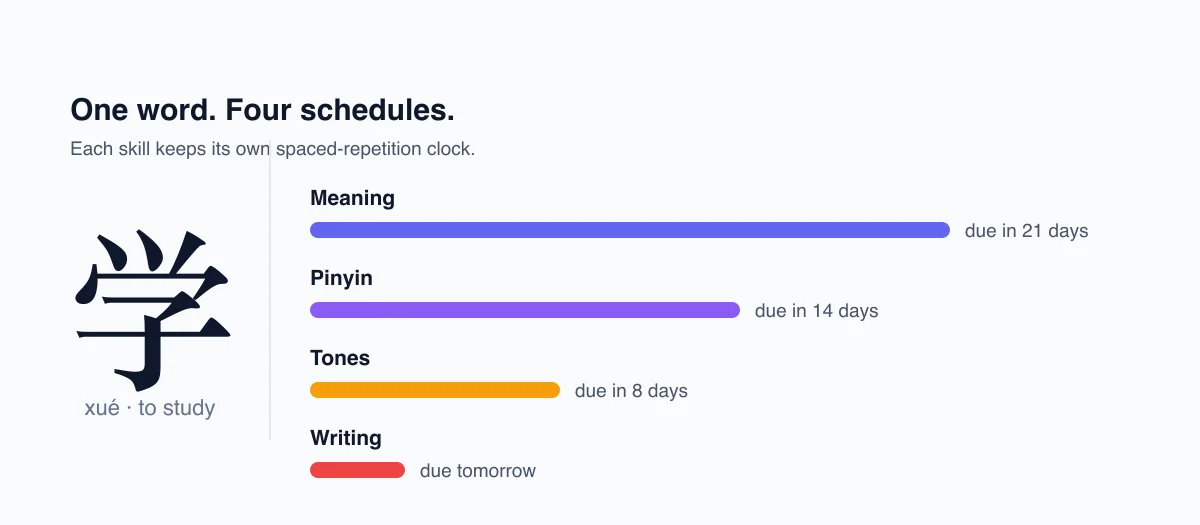
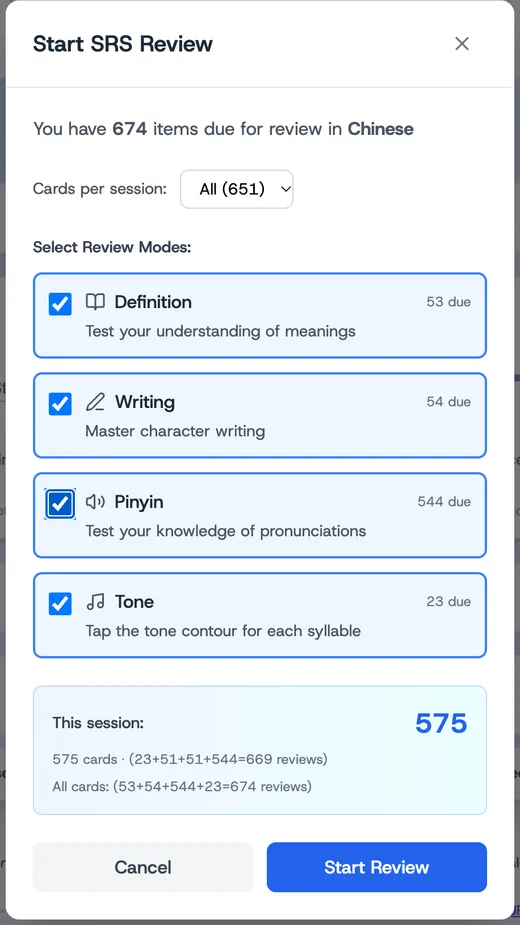
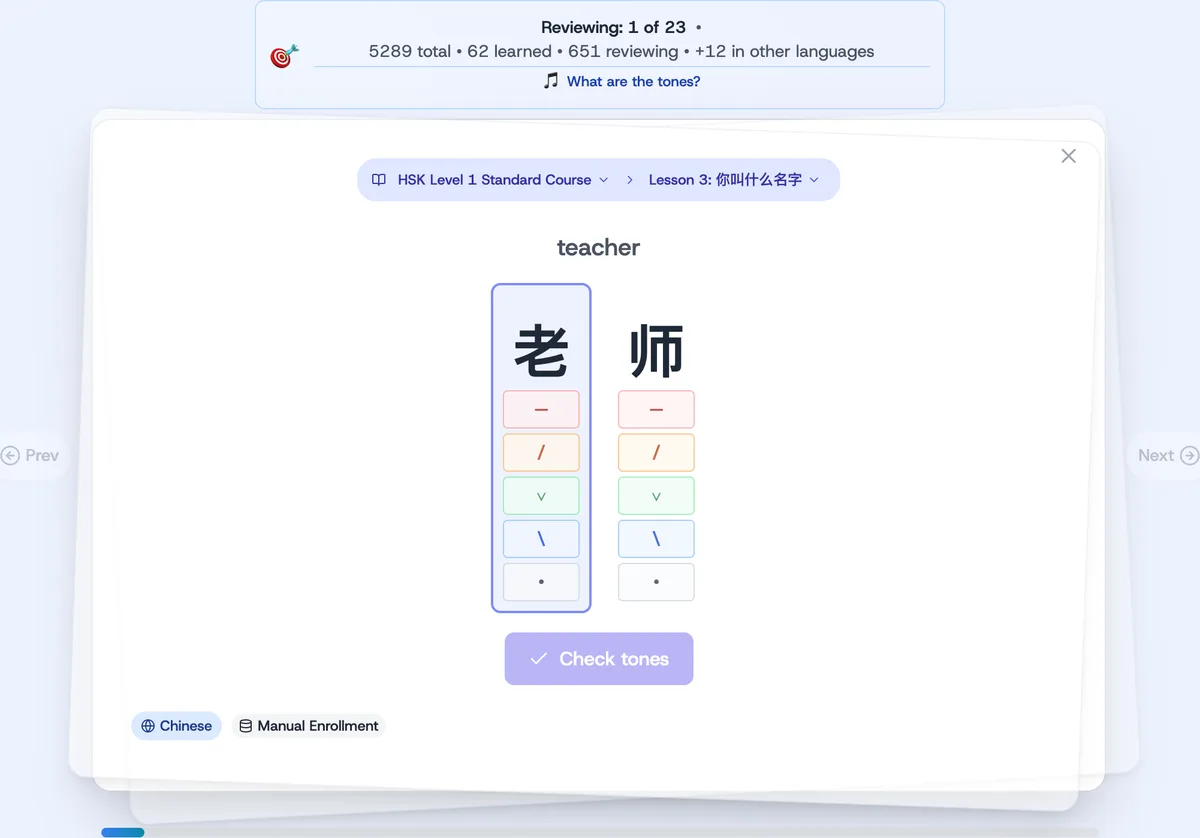
When you enroll a Chinese word in Hidden Dragon, you don't get one card. You get four review tracks, definition, pinyin, writing, and tones, and each runs its own SM-2 schedule with its own memory state.
学 isn't "a card due in three weeks." It's four items:
- 学 → meaning, on whatever interval your meaning-recall earns
- 学 → pinyin, separately, because producing xué from characters is a different act from recognizing a gloss
- 学 → writing, where you build it from memory (why we teach characters this way)
- 学 → tones, where you name the tone of every syllable
If my writing recall slips, writing mode shows up tomorrow. Meaning might not be due for three weeks, because meaning is fine. Re-enroll a book or change your modes later and nothing is lost; each track keeps its own history.
Enrollment defaults to all four. For some levels that's too much queue. My recommendation for thinning it is at the bottom.
Definition
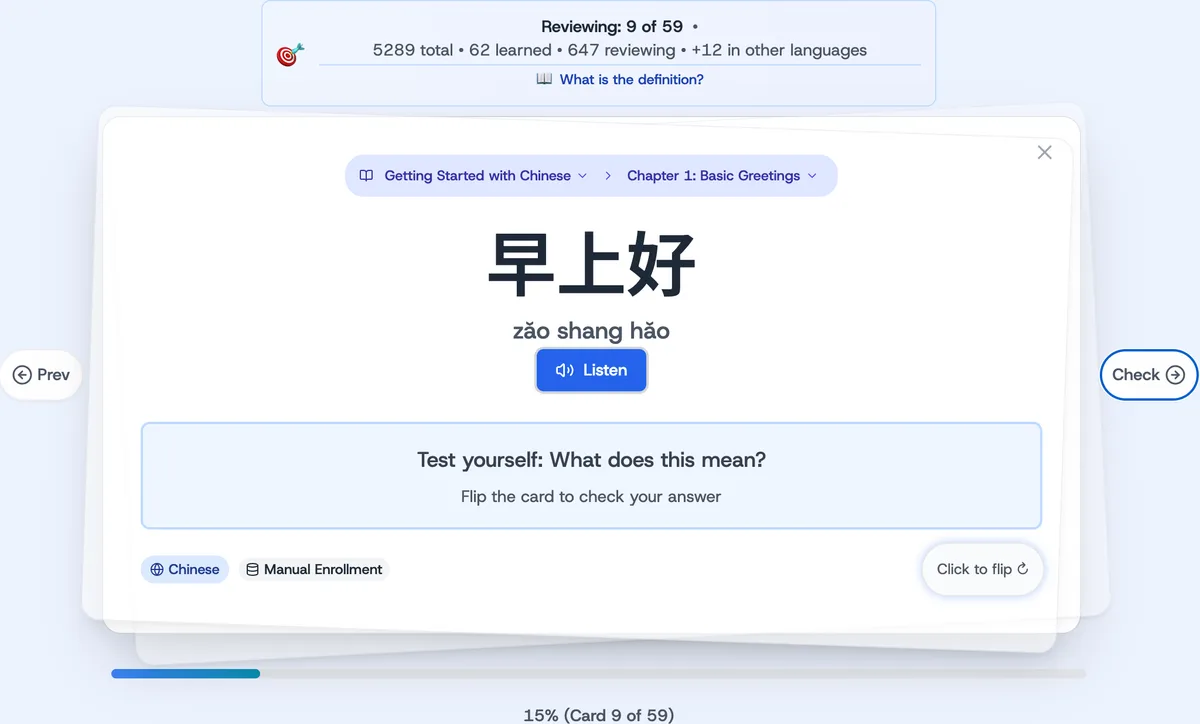
The baseline. See the word, recall the meaning, grade yourself. This is the track that makes graded reading possible, and it's where context earns its keep: 东西 means "thing," but which thing, used how? Definition reviews connect to real example sentences because meaning lives in usage.
There's an optional pronunciation check on these cards too: say the word before you flip, get scored on it.
Pinyin
The same card, flipped. Characters shown, pronunciation hidden. The usual objection is that pinyin is a crutch you outgrow, which is true of reading pinyin printed under characters. It is not true of producing the sound from the character, which is the skill listening depends on. That production decays like anything else, so it gets a curve.
Writing
You will type Chinese, not write it, and typing is fine for most of life. I keep a writing queue anyway because character production is the deepest processing a character gets.² You cannot write 想 from memory without knowing it is 相 (sound) over 心 (meaning), and that structural knowledge pays off on every character you haven't learned. It's also why the 己, 已, 巳 family stops being confusable once your hand knows them.
In writing mode the card starts face-down. You get the meaning and build each character, stroke order enforced, graded per character. Failed characters return later in the same session, so you finish having written everything correctly. Expect the shortest intervals here and the slowest growth. That's signal.
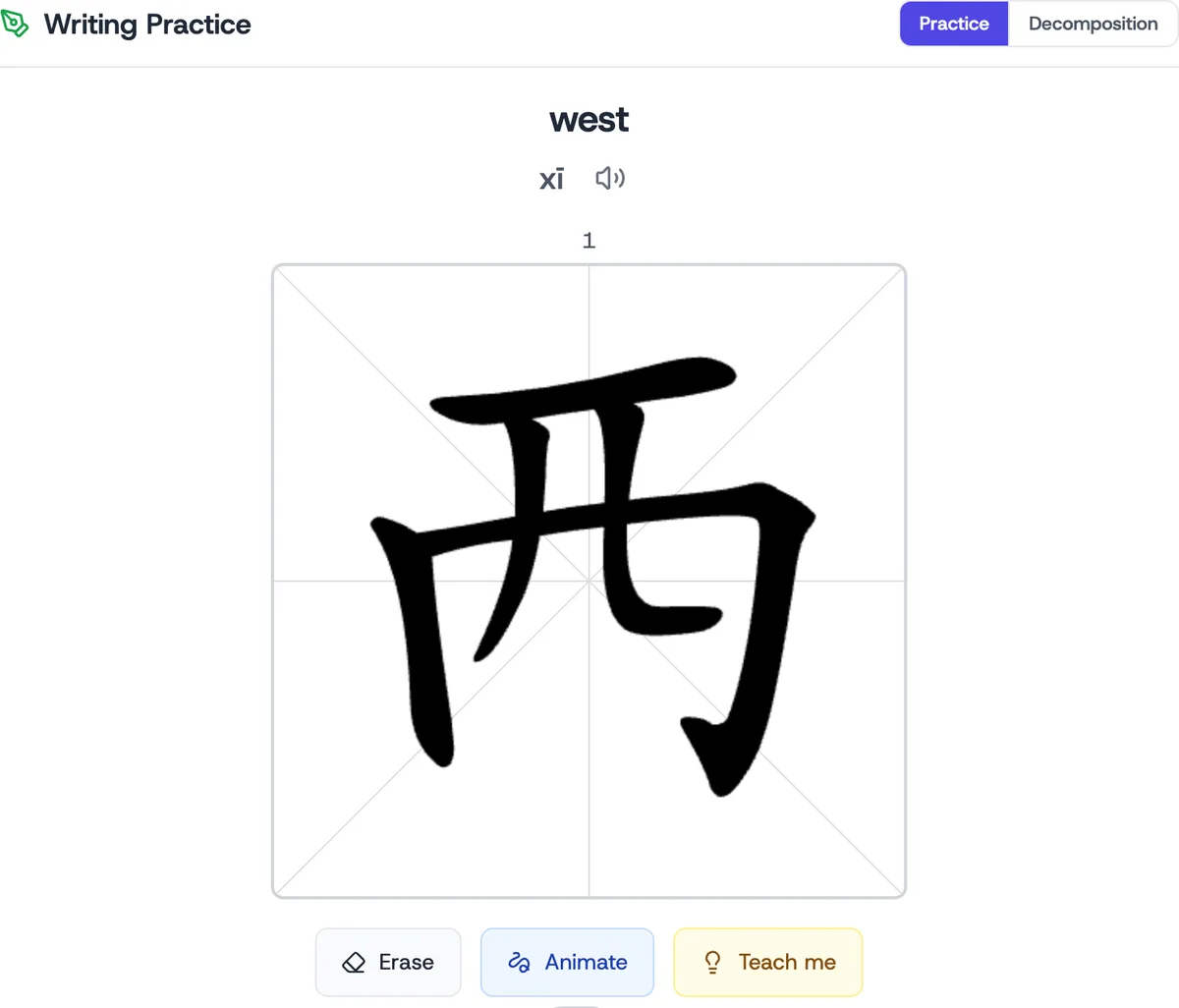
Writing SRS is part of Hidden Dragon Pro. I still maintain a Skritter streak in parallel because that review history cannot be exported; how the tools compare is on the flashcards comparison.
Tones
Now the hard one, and the center of this post for me personally. My tones were never great. Seventeen years of daily review, tones tested the whole time, and they're still off.
Two things I've learned about why.
First, tone knowledge and tone production are different skills. Testing whether I know a word's tone maintains the knowing. Saying it is more like violin: a motor skill that wants daily practice and regresses when you skip. I took Rita Laoshi's FYMV class and the pronunciation bootcamps, and their core message is the same one every violin teacher gives. Regression doesn't only threaten tones: keep a review streak forever and never open your mouth, and output, pronunciation, everything production-shaped, drifts.
Second, and this surprised me when I went looking: even the knowledge side is fragile. There's a documented gap in L2 Mandarin learners between identifying tones and knowing which tone a specific word carries, and it persists even in advanced learners.³ You know the phrase and hesitate on the tone. That never happens to native speakers. In my experience they'll guess what you meant from context and still wince at how you said it.
That double fragility is why tones get more machinery in Hidden Dragon than anywhere else. Tone SRS is the schedule: the card shows the word, you name the tone of every syllable, and after the check the word is spoken. The Tone Trainer game trains the discrimination side, telling 妈 from 马 under real audio, which is a different skill from remembering. Speak Lab and the pronunciation scorer are the production side. The tone tutorial teaches the phonology, including how third tones change before other third tones. I built all of it first for myself, out of that class and those bootcamps. Now I think it's useful to other people too.
Which modes to turn on
Enrollment defaults to all four, and for HSK 5+ I'd leave it there. Earlier, thin it out:
- HSK 1–2: definition and pinyin. Add tones early if you do any listening, because tone habits fossilize early, good ones and bad ones alike.
- HSK 3–4: all four, or writing limited to characters you'll produce by hand. A handwriting-heavy textbook earns writing mode; a listening-focused deck doesn't.
If you want to try this, definition reviews are free for as long as you like: enroll any chapter, pick your modes, and the schedules take it from there.
What this doesn't fix
Four tracks are four reviews, and enrolling everything in all modes quadruples a queue that was already nontrivial. The defaults are generous on purpose, but generous isn't the same as right for everyone.
The production tracks are Chinese-only for now. French learners currently get the definition track, and "typing is writing" is a limitation to admit rather than a solution to claim.
Speaking has no schedule. The streak will keep your vocabulary alive for years; it will not keep your mouth in shape, because it never tests it. Pronunciation checks ride along on definition and pinyin cards when you opt in, and that's the edge of this design.
And no curve teaches what you never saw. SRS maintains memory. Something has to put it there first.
The streak is still going. If past-me could ask present-me one question about those seventeen years, it wouldn't be how many days. It would be: what did you say out loud today?
¹ Roediger, H. L., & Karpicke, J. D. (2006). Test-enhanced learning: Taking memory tests improves memory. Psychological Science, 17(3), 249–255. ² Slamecka, N. J., & Graf, P. (1978). The generation effect: Delineation of a phenomenon. Journal of Experimental Psychology: Human Learning and Memory, 4(6), 592–604. ³ Pelzl, E., Lau, E. F., Guo, T., & DeKeyser, R. (2021). Even in the best-case scenario L2 learners have persistent difficulty perceiving and utilizing tones in Mandarin. Studies in Second Language Acquisition, 43(4).