


You are reading a menu. You see 己. Or is it 已? You stall, glance at the context, guess, and keep moving. It happens every time you read in Chinese, and it is not a you-problem. It is how the writing system was built.
Around 452 characters fall into clusters where two, three, sometimes four of them look almost identical. 人 and 入. 土 and 士. 未 and 末. 己, 已, and 巳. You can study each one to perfection and still freeze the moment you have to pick between them in real text.
Why This Happens
Chinese characters are assembled from a small set of building blocks. Somewhere around two hundred radicals, plus a few hundred component shapes, recombined into tens of thousands of characters. Visual collisions are inevitable. And the collisions are not random. They cluster in predictable ways.
There are three flavours:
- Visual. Characters that look almost identical. One stroke longer. A line that closes instead of opens. 土 versus 士. 己 versus 已 versus 巳.
- Phonetic. Characters that sound the same or nearly the same. 的, 地, and 得 are the famous one. 在 and 再. Tone-family pairs that trip your ear.
- Semantic. Different characters with overlapping meaning or grammar role. 会 and 能. The particle salad that is 的, 地, 得 again, but this time for a different reason.
Most apps teach characters one at a time. That is exactly backwards if your problem is telling two apart. You do not need another pass on 己. You need to see 己 and 已 side by side, be forced to choose, and find out which stroke was the one that mattered.
Train the Contrast, Not the Character
This is the rule nobody tells you: confusables cannot be solved by studying each one harder. You have to train the contrast itself. Present the alternatives together, force a decision, give feedback that points at the specific difference.
That is a discrimination task, not a memorisation task. Your brain builds a different kind of representation when it is asked to distinguish two similar things versus when it is asked to recall one thing in isolation. Flashcards are good at the second job. They are bad at the first. You need a tool built for the first.
How the Confusables Game Works
Open the Games menu and pick Confusables. Choose a difficulty level. Baby Dragon gives you the simplest pairs (人/入, 己/已/巳). Master Dragon gives you the ones that humble advanced readers. Or hit Mixed and get all 204 groups shuffled together.
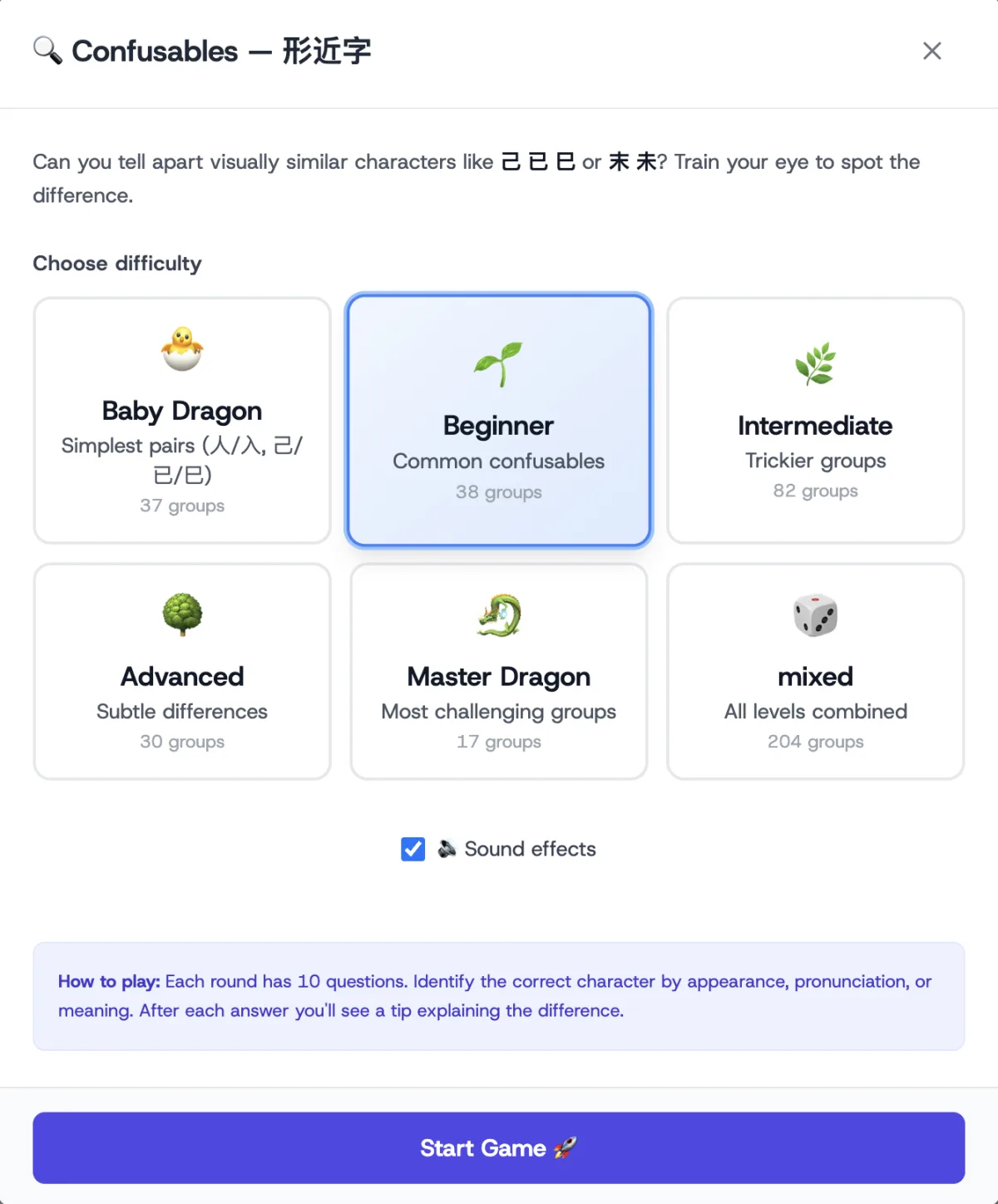
Each round shows you the pinyin or the English meaning, then asks you to pick the correct character from two to five options. Get it wrong, you see a mnemonic tip pointed at the exact difference. Not "try again." Something concrete you can actually remember.
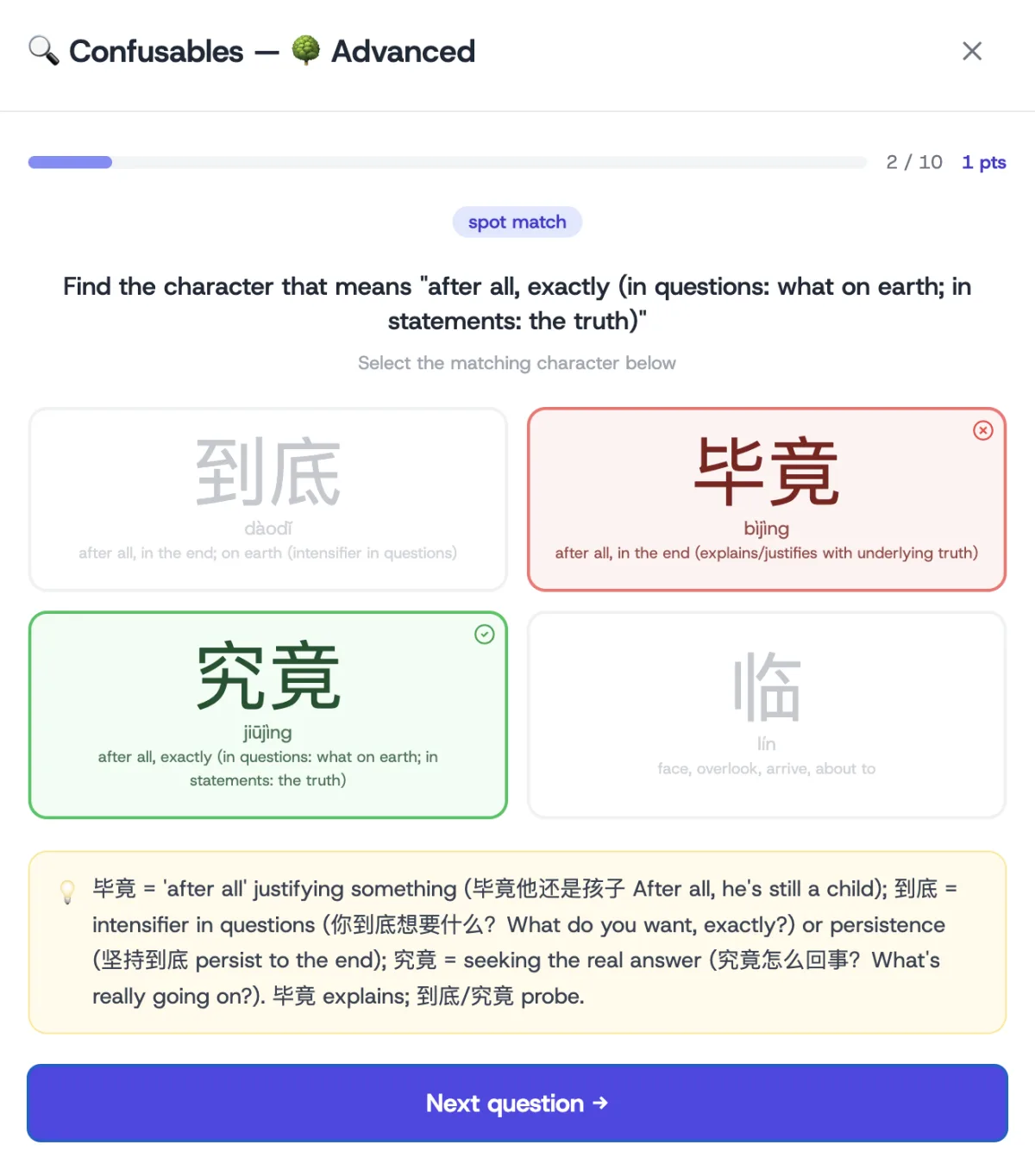
That tip is the whole point. It is also what separates this from every static "characters that look alike" list on the internet. You get the contrast and the reason, together.
The groups are not random. The visual pairings draw on Carl Gene Fordham's Top 258 Most Commonly Confused Chinese Characters and Wiktionary's Easily Confused Chinese Characters appendix; phonetic and semantic groupings are Hidden Dragon's own. The game covers all three flavours. Visual gets the most attention because that is where the damage is.
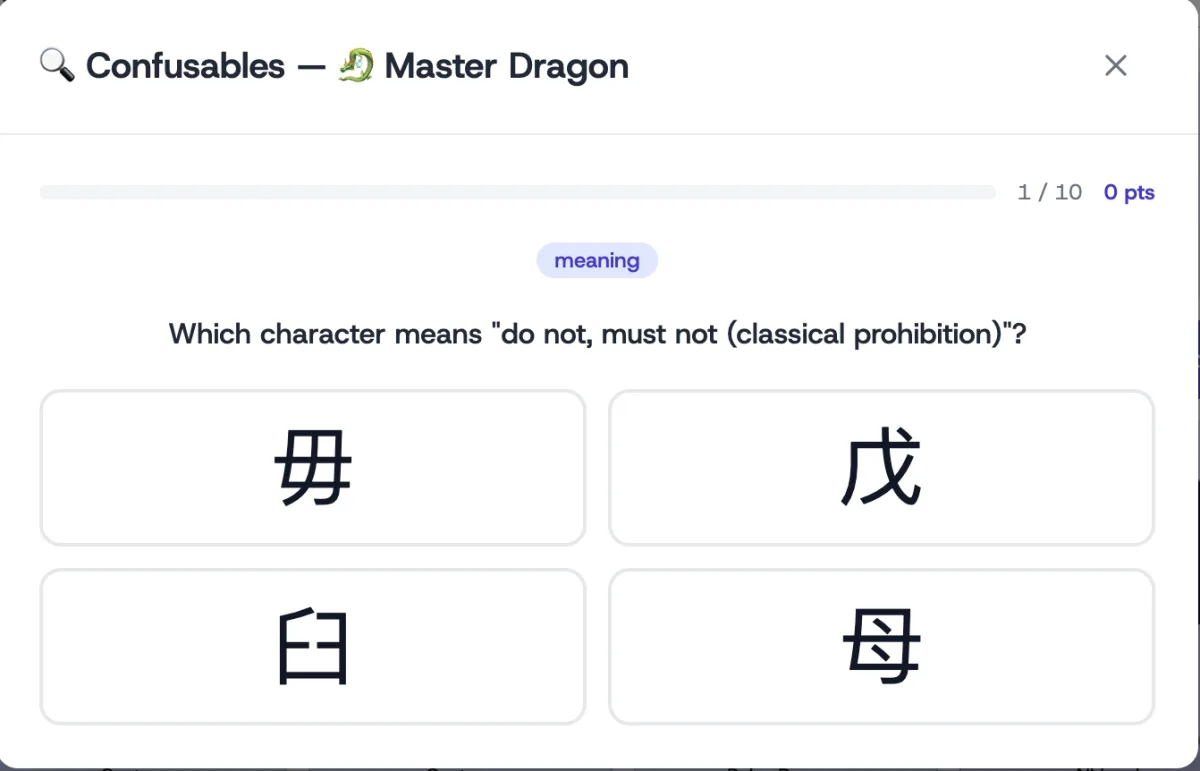
At the top of the difficulty ladder, every option on the screen is a legitimate trap. If you thought you were good at characters, this is the level that checks.
How To Use It
Five minutes before a reading session or a flashcard round. The game warms up the exact discrimination your brain has to do when it meets real text. Not a replacement for vocabulary study. A complement to it.
Run it every few days on mixed mode. You will discover pairs you thought you knew. The characters you have been silently guessing at in every sentence will start to separate.
If your Chinese has plateaued on reading and you cannot figure out why, this is probably part of the answer. You have been doing flashcard reps on individual characters and then losing confidence the moment two similar ones show up next to each other. Fix that directly.
For the broader case that recognition and production are different skills that need different training, read Why One Study Method Is Never Enough. For the other half of the "characters that trip you up" problem (tones, not shapes), start with How to Learn Chinese Tones Without Going Crazy.
Visual confusables list used with the kind permission of Carl Gene Fordham, drawn from his Top 258 Most Commonly Confused Chinese Characters, and supplemented with Wiktionary's Easily Confused Chinese Characters appendix (CC-BY-SA 4.0). Hero photo by buddhaelemental3d on Unsplash.