

Mandarin Chinese has four tones, plus a neutral tone, and every syllable carries one. This terrifies beginners. It shouldn't. With the right mental model, tones become one of the most learnable parts of the language.
Why Tones Matter
The classic example: mā, má, mǎ, mà. All spelled "ma" but meaning mother, hemp, horse, and scold respectively. Context prevents most misunderstandings in real speech, but getting tones consistently right marks you as a serious learner.
The Four Tones (Plus Neutral)
Think of each tone as a musical contour, not a fixed pitch.
Tone 1, high and flat (ā). Hold a steady, high pitch. Like singing one long note. Example: 妈 mā (mother).
Tone 2, rising (á). Start mid, end high. Like asking "Really?" in English. Example: 麻 má (hemp, numb).
Tone 3, dipping (ǎ). Start mid, dip low, then rise. The most mislearned tone. Example: 马 mǎ (horse).
Tone 4, falling (à). Start high, drop sharply. Like saying "No!" in English. Example: 骂 mà (to scold).
Neutral tone. Short and light, no contour. Common in particles like 吗 ma (question marker).

The Third Tone Trap
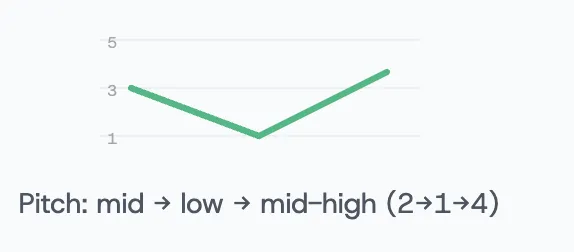
Most learners get tripped up by Tone 3. Textbooks show it as a full dipping contour (2-1-4 on a five-point scale). But in natural speech, Tone 3 before another tone almost always becomes a low-falling half-tone, starting mid and staying low.
In natural speech, Tone 3 before another tone becomes a low-falling half-tone. It starts mid and stays low, with no rise.
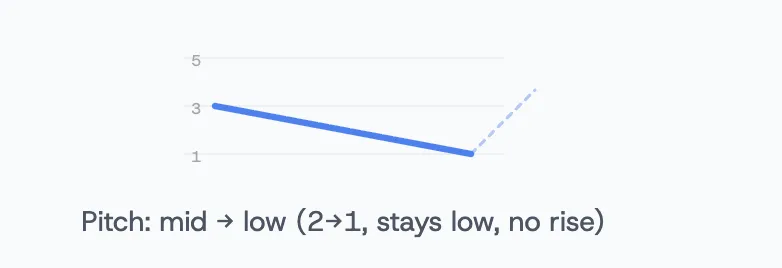
You only use the full dipping shape when the syllable is spoken in isolation, at the end of a phrase with emphasis, or before a pause.
In connected speech, Tone 3 + Tone 3 becomes Tone 2 + Tone 3. So 你好 (nǐ hǎo, hello) is actually pronounced níhǎo in practice.
Hidden Dragon's Tone Guide covers this in depth with audio examples.
A Mnemonic System That Works
Associate each tone with a simple gesture:
| Tone | Gesture | Sound feel |
|---|---|---|
| 1st | Hold hand flat, palm down | Steady, calm |
| 2nd | Raise hand upward | Questioning |
| 3rd | Dip hand down then up | Scooping |
| 4th | Chop hand downward | Decisive |
Practice tapping the gesture while saying tones aloud. Your muscle memory encodes both together, which makes tone recall faster during conversation.
Train Your Ear with the Tone Trainer Game
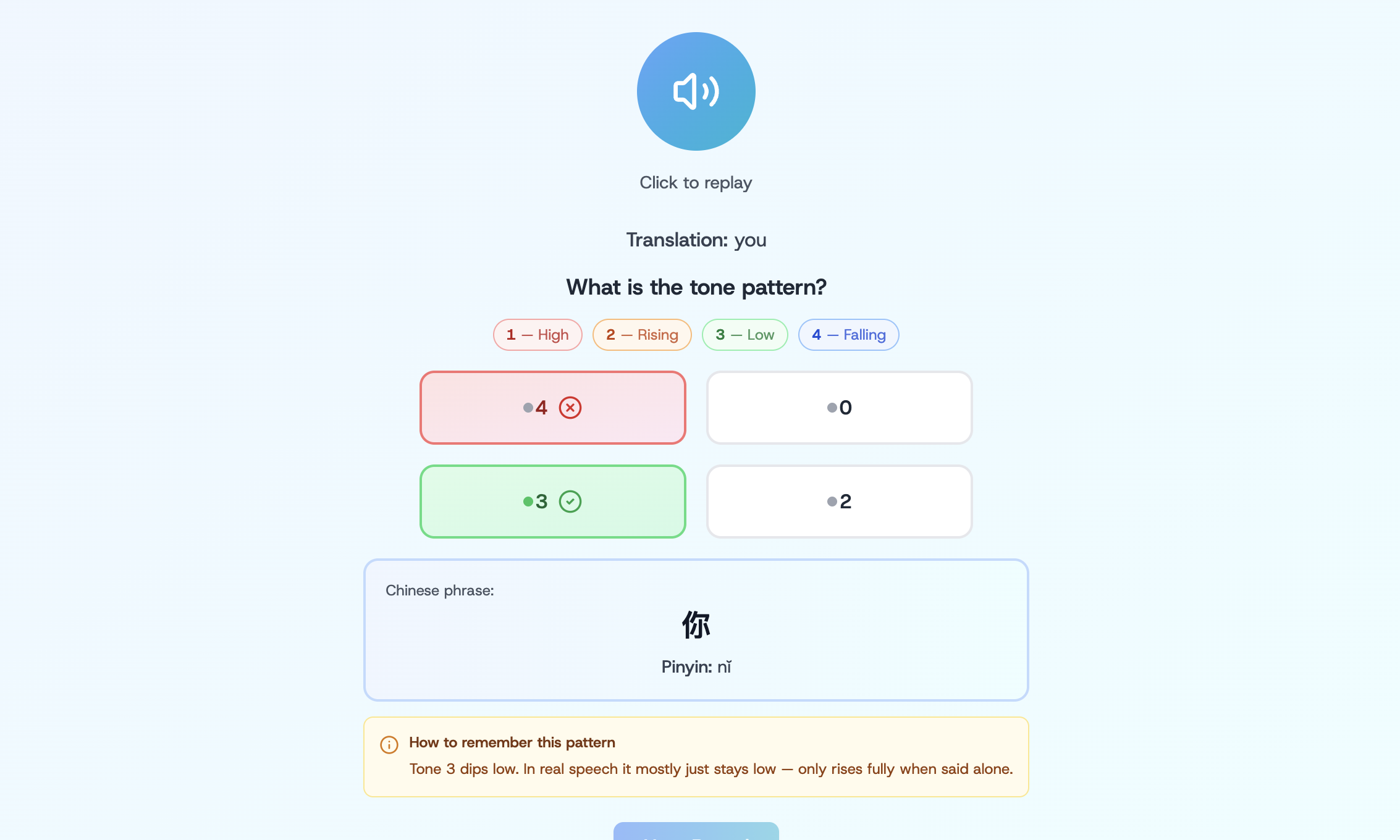
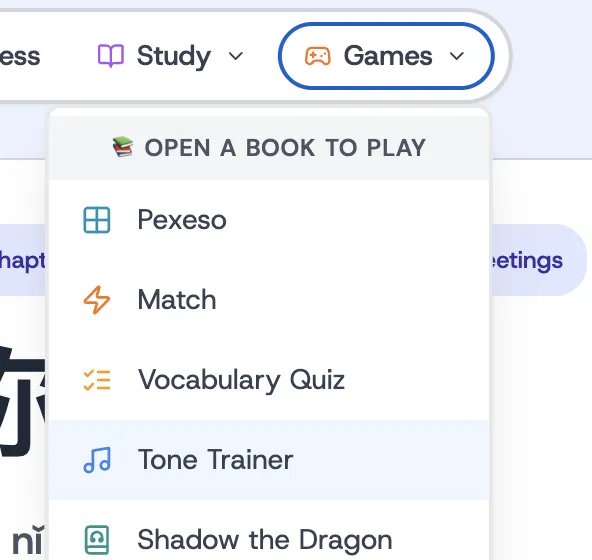
Knowing the tones is different from hearing them reliably. Hidden Dragon's Tone Trainer plays a word and asks you to identify the tone pattern. It is the fastest way to build automatic recognition, the kind that makes real listening comprehension possible. Ten minutes a day with it will do more for your ear than an hour of passive listening. To try it, open any book and go to Games, then Tone Trainer.
Minimal Pairs Practice
The most effective drill: pick two words that differ only in tone and practice them back-to-back.
- 买 mǎi (to buy) vs 卖 mài (to sell)
- 问 wèn (to ask) vs 文 wén (culture/language)
- 书 shū (book) vs 熟 shú (cooked/ripe)
Three pairs per day, five minutes per session, consistently beats hour-long cramming.
Common Mistakes to Avoid
Treating tones as absolute pitch. Tones are relative contours. A person with a low voice and a person with a high voice can both produce all four tones correctly. They just anchor to their own natural range.
Neglecting the neutral tone. Students often stress neutral-tone syllables when they shouldn't, making speech sound robotic. Keep them light and brief.
Skipping connected speech practice. Drilling isolated syllables helps you learn the sounds, but real fluency comes from hearing and producing tones in words and phrases. Start with two-syllable words, then short sentences.
The Practice Loop
- Hear the tone in isolation (use Hidden Dragon's audio on each card)
- Shadow the audio immediately, do not wait
- Record yourself and compare
- Practice the same word in a phrase: 马 becomes 一匹马 (a horse)
- Meet the word in a story, context cements memory
The Hidden Dragon Tone Guide walks you through all of this interactively, with 48 audio examples and a quiz at the end.
The biggest mistake learners make is waiting until their tones are "perfect" before speaking. Start speaking now. Tones improve with exposure and feedback, not from studying them in isolation. Get the sounds in your ear, get them in your mouth, and the brain will sort the rest out. If you want to understand why speaking practice requires its own deliberate effort beyond listening and reading, this post on recognition versus production explains the gap.
Once your tones are solid, the next step is hearing them in the wild. Regional accents change the rules. Read why Sichuan and Taiwan Mandarin sound so different from what you practised. And if you want real-time feedback on your own pronunciation, the pronunciation trainer is where to go next.