

Ask any Mandarin learner about their first taxi ride in China and you will hear the same story.
You studied. You practised your tones. You felt ready. Then the driver opened his mouth and your three years of Mandarin evaporated. Not because your Mandarin was bad. Because the Mandarin you learned and the Mandarin you were hearing were not the same thing.
This is the regional accent problem. Most learning tools do not let you practise responding to it.
It also compounds the tone problem. If you are still working on getting your tones right, regional accents add another layer. The same tone can sound completely different depending on where the speaker is from.
Why Mandarin Sounds Different Across China
Putonghua, Standard Mandarin, is the official spoken standard used in schools, national media, and formal settings. It is based on Beijing Mandarin and is what every mainstream course teaches you.
It is also not how most people naturally talk at home, with friends, or to that taxi driver at 11pm.
China covers an enormous amount of ground. Mandarin has been shaped by centuries of regional influence, from Wu in the east to Cantonese in the south to the distinct flavours of the northeast. The result is a set of accents that share vocabulary and grammar but sound different enough to throw off a learner who has only ever heard studio-produced audio.
Once you know what to listen for, the patterns are systematic. You can learn them.
Accent vs dialect: Shanghainese and Cantonese are dialects (方言 fāngyán): different vocabulary, different grammar, often unintelligible to Mandarin speakers. What you encounter in Chengdu or Taipei is accented Mandarin (口音 kǒuyīn): the same language, with different sounds. The Scenarios game trains the accent, not the dialect.
Sichuan Mandarin: What to Expect in Chengdu
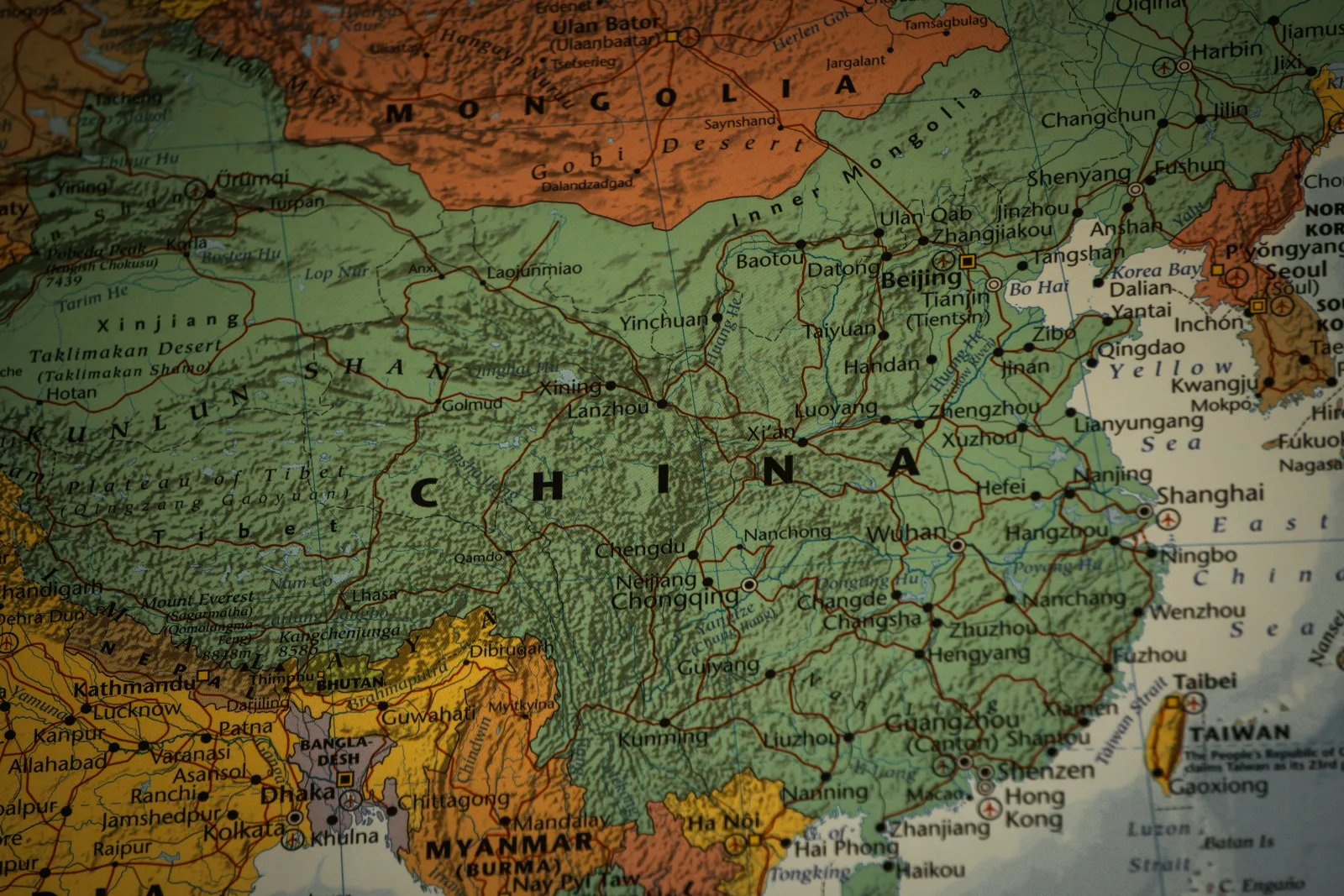
Sichuan Mandarin is spoken across Sichuan province and Chongqing. Chengdu alone has 14 million people. If you are visiting for the food, the pandas, or both, this is the accent you will encounter.
The most noticeable feature: retroflex consonants disappear. The zh, ch, sh sounds that Standard Mandarin emphasises become z, c, s. So 是 (shì) sounds closer to sì, and 吃 (chī) sounds closer to cí. Tones shift too, with the fourth tone sounding flatter than you are used to.
Sichuan speakers understand standard Mandarin and most will adjust toward it when speaking to a foreigner. But in a fast conversation at a hotpot restaurant, asking for directions, or haggling at a market, the accent comes through and your ear needs to be ready for it.
What to listen for: Start with food orders. 吃 (eat), 什么 (what), and 这个 (this one) all sound noticeably different in Sichuan Mandarin. If you can recognise those three in their Sichuan form, you have a foothold.
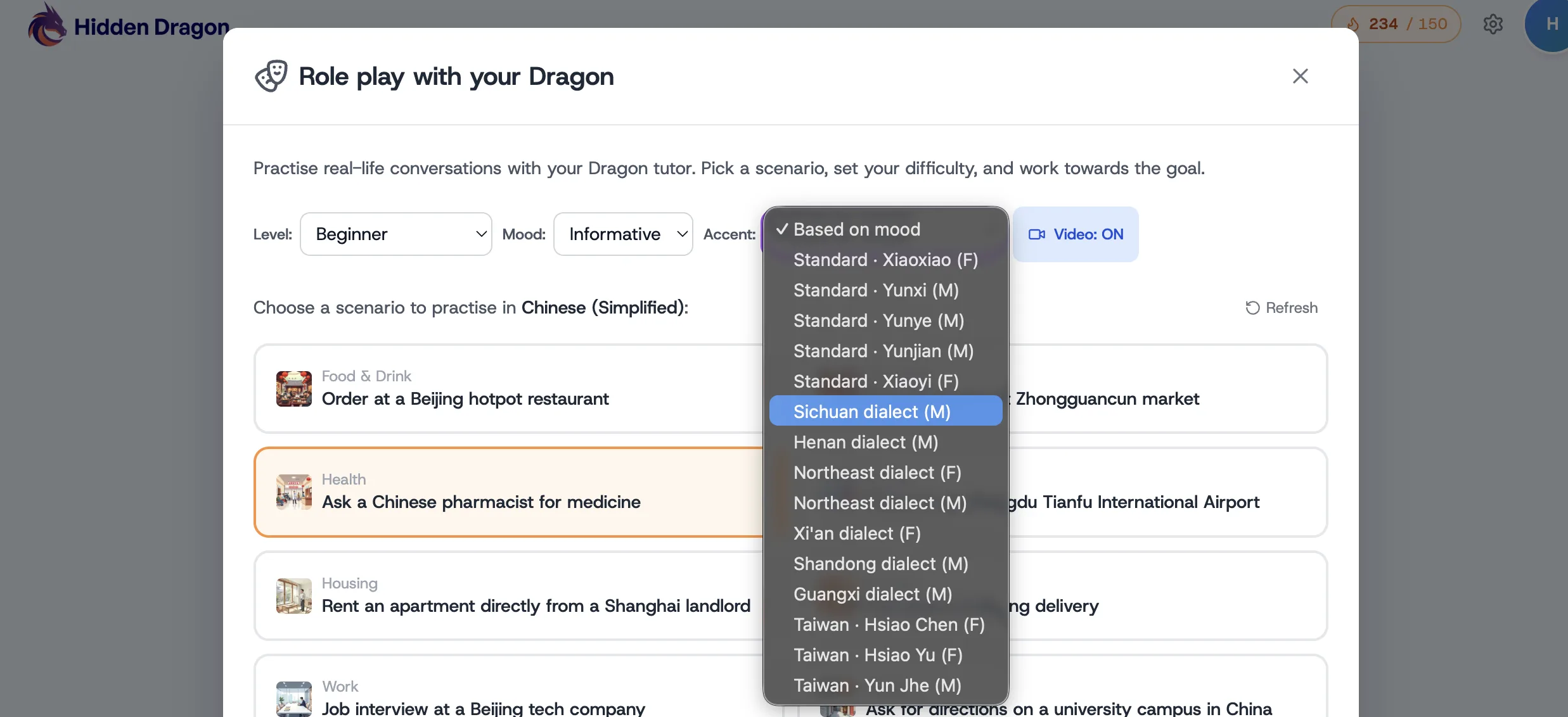
In Scenarios: Sichuan Mandarin is available with a male voice. Set it before your next hotpot or market scenario.
Dongbei Mandarin: The Northeast Sound
Dongbei refers to China's northeastern provinces: Heilongjiang, Jilin, and Liaoning. The accent is distinct and, once you hear it, very recognisable.
The defining feature is heavy 儿化 (érhuà), where an "r" sound rolls onto the end of words. Beijing Mandarin uses érhuà too, but the northeast takes it further and with more energy. The rhythm of Dongbei speech is faster and more emphatic than standard Mandarin.
Dongbei Mandarin is everywhere in Chinese popular culture. A large share of Chinese comedy, variety shows, and internet content comes from the northeast. If you watch any Chinese video content at all, you have been hearing this accent without knowing it.
What to listen for: The érhuà on common words like 哪儿 (where), 这儿 (here), and 什么事儿 (what's the matter). In Dongbei, these come thick and fast. Training your ear to expect the "r" tail means you stop losing the word entirely when it appears.
In Scenarios: Dongbei Mandarin is available with both male and female voices. The rhythm difference is immediately noticeable even on the first exchange.
Taiwan Mandarin: A Different Rhythm
Taiwan Mandarin developed separately from mainland standard Mandarin and sounds noticeably different.
The retroflex consonants that Beijing Mandarin leans on, zh, ch, sh, are softened or dropped in most contexts, similar to Sichuan but for different historical reasons. The pace is slower and the intonation has a slightly musical quality. It is generally easier to parse than northern mainland Mandarin, but the differences in rhythm and vocabulary still catch people off guard.
Learners who study mainland-standard Mandarin and then visit Taipei often find the experience disorienting. The words are the same. The feel is not.
What to listen for: The pace and the particles. Taiwan Mandarin uses 啊 (a) and 喔 (o) as sentence-final particles far more than mainland Mandarin, and with different intonation. Once you recognise them as rhythm markers rather than meaningful words, conversations become much easier to follow.
In Scenarios: Taiwan Mandarin is available with three voices: Hsiao Chen (F), Hsiao Yu (F), and Yun Jhe (M). Train your ear to both male and female speakers.
The Real Problem Is Comprehension, Not Pronunciation
Most learners assume accent training is about how they sound. The bigger problem is understanding the other person.
You can speak perfect Putonghua and be understood almost anywhere in China. What you cannot do is guarantee you will understand the reply. A Sichuan taxi driver, a Dongbei market vendor, a Taipei café owner. They are all speaking Mandarin. It just does not sound like the Mandarin in your head.
This is why passive listening practice only goes so far. Watching TV with subtitles gives you exposure, but it does not put you under pressure. The moment you are in a real conversation and the other person says something your brain does not recognise, you need to have practised recovering: asking for clarification, parsing the sounds again, holding the thread.
That is a skill. It needs active training.
How to Practise Regional Mandarin Accents
Reading about accents helps. Listening to native speakers helps more. But the fastest way to build ear training for a specific accent is to have a conversation in it, to be forced to respond in real time to the sounds you are learning.
Hidden Dragon teaches standard Mandarin in the flashcard decks. The Scenarios game is where the regional accents come in.
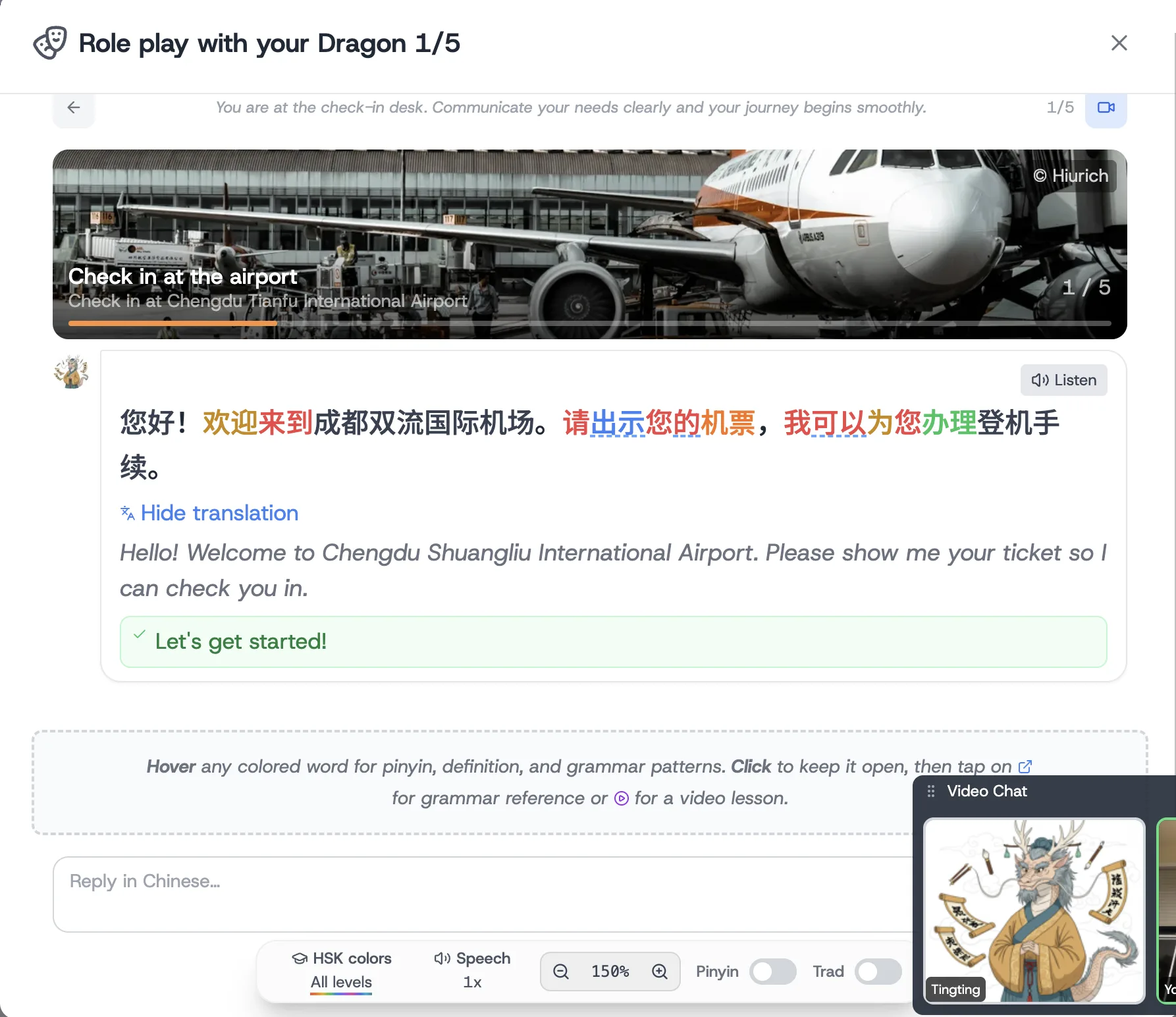
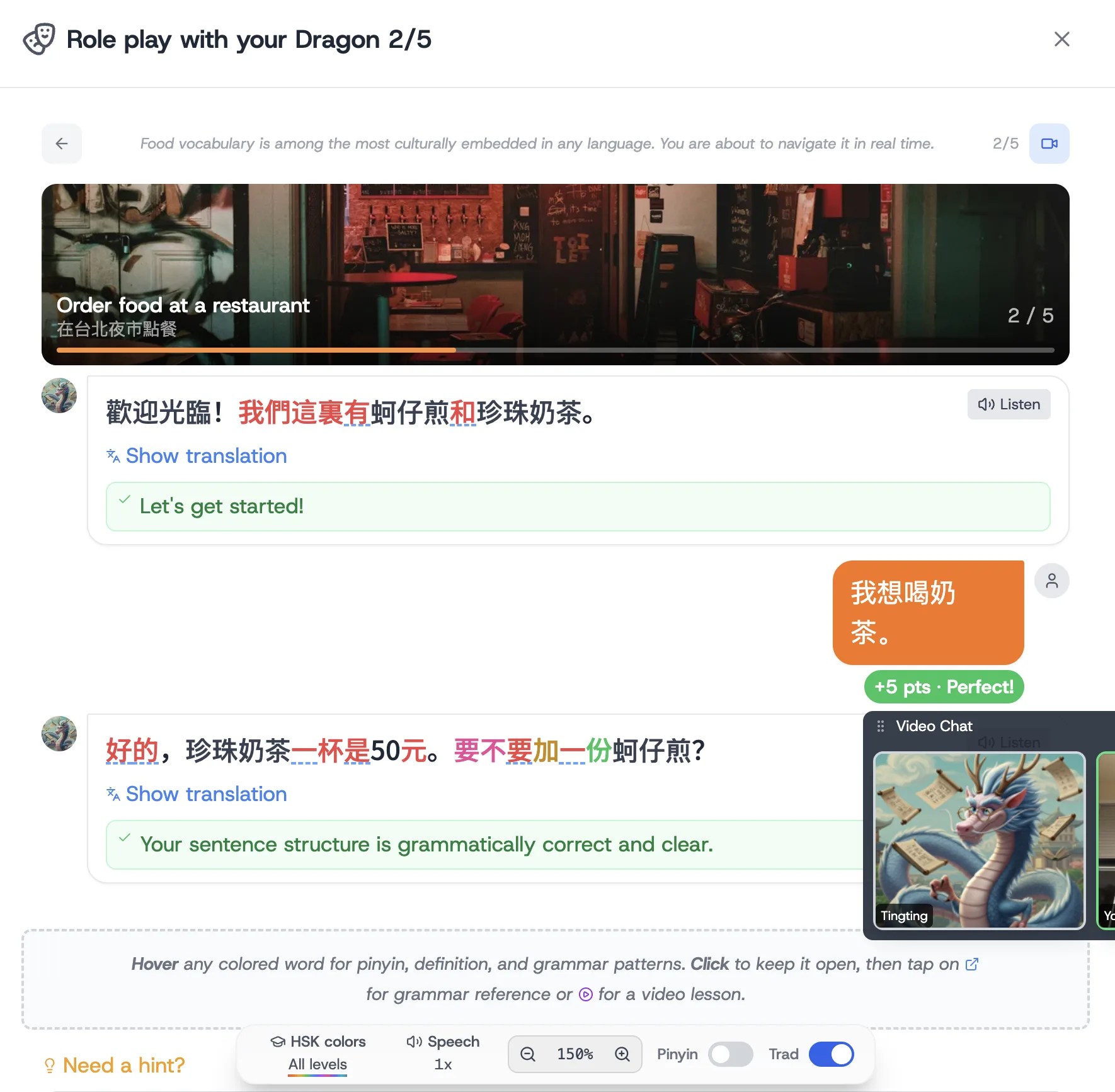
Pick a scenario (ordering food, navigating a hospital, haggling at a market), set your difficulty, and choose the accent. Your Dragon plays the role. You respond. Corrections appear inline as you go, with a full assessment at the end.
The words are the same. The sound is not. That is the part no textbook prepares you for.
A few sessions with Sichuan Mandarin before a trip to Chengdu will not make you fluent in the dialect. It will train your ear to the sound of it, build familiarity with the consonant shifts, and mean that when someone at a hotpot place says something that sounds distinctly local, you have a fighting chance of following along.
Including, eventually, the taxi driver.
Supported Chinese Accents
In addition to Standard Mandarin, Hidden Dragon supports the following regional accents in Scenarios:
- Sichuan: zh/ch/sh become z/c/s, shifted tones
- Henan: central plains Mandarin, distinct vowel sounds
- Northeast / Dongbei: heavy érhuà, energetic rhythm
- Xi'an: Guanzhong dialect influence, distinct fourth tone
- Shandong: coastal northeast Mandarin
- Guangxi: southern Mandarin with tonal variation
- Taiwan: softened retroflexes, slower cadence
Scenarios is a Pro feature. Available in the Games menu under Scenarios.
New to Scenarios? Read Your Dragon Will Now Take Your Order for the full picture of how the game works.
Hero photo by Liam Read on Unsplash.