Most pronunciation practice is passive. You listen to a native speaker, you try to repeat what you heard, you compare the result. You are training your ear and hoping your mouth follows.
Shadowing is different. You speak at the same time as the audio, not after it. Your mouth has no choice but to keep up.
What Is Shadowing?
Shadowing was developed and named by linguist Alexander Arguelles, who used it to reach high proficiency in dozens of languages. The technique is simple: play audio of a native speaker and speak along with it simultaneously, matching the rhythm, speed, and intonation as closely as you can. Not after the sentence ends. During it.
The effect is different from repetition practice. When you repeat after audio, you are working from memory. When you shadow, you are tracking a moving target in real time. Your attention goes to the sound itself rather than your reconstruction of it. The gap between what you heard and what you are producing collapses.
Why It Works for Mandarin Specifically
Mandarin makes shadowing more valuable than it is for most other languages, for one reason: tones.
A tone is not just a sound. It is a contour: a movement from one pitch to another over the course of a syllable. To produce it correctly, you need to feel it happening in your mouth and throat, not just recognise it with your ear. That physical, kinetic sense of a tone is something passive listening cannot give you.
Shadowing forces you to produce tones in real time, at natural speed, inside connected speech. You cannot pause to think about whether 是 needs a falling tone. You just say it, because the audio is already past it. Over enough repetitions, the tone becomes automatic. That is the goal.
Vocabulary still has to come from somewhere—pair shadowing with SRS and graded reading. Our guide to best Chinese flashcard & vocabulary apps compares the stacks learners actually combine with speaking practice.
Connected speech is the other reason. Standard Mandarin as taught in textbooks has clear syllable boundaries. Natural Mandarin does not. Words blur into each other. Tone sandhi changes 不 and 一 depending on what follows. Shadowing trains your mouth to handle these patterns because you are producing them, not studying them.
Two Stages of Shadowing Practice
Not all shadowing is the same. There is a passive version and an active version, and they train different things. The right sequence is passive first, active second.
Three techniques, one progression
Repetition: listen first, then repeat after the speaker finishes. Good for beginners focusing on individual sounds.
Read-Along: speak simultaneously with the audio while reading the text. Builds fluency and confidence with visual support.
Shadowing: speak along 1-2 seconds behind the audio, matching pronunciation and intonation as closely as possible. The most demanding of the three, and the most effective for natural-sounding speech.
The stages below follow this progression. Start where you are.
Read-Along: shadow with text. Read along with audio while speaking simultaneously. You can see the characters, you know what is coming, and the pressure is lower. This is where you build the basic muscle memory: getting your mouth moving at the right speed, feeling the rhythm of the sentence, internalising tones without stopping to think about them.
The karaoke read-along mode in Hidden Dragon stories is built for this. Each sentence highlights as it is spoken aloud. You follow the text and shadow the audio. The combination works because the character gives you a moment of prediction. You see 吃 a fraction of a second before you hear it, which means your mouth is already preparing.
Pick a story at your level. Turn on read-along. Shadow every sentence. Do it until the rhythm feels natural before moving on.
Shadowing: without text. Same technique, no visual support. You are working from sound alone. This is where the real gains happen. Your ear has to do the work your eyes were doing before. If you lose the thread, you lose it. That pressure is part of the training.
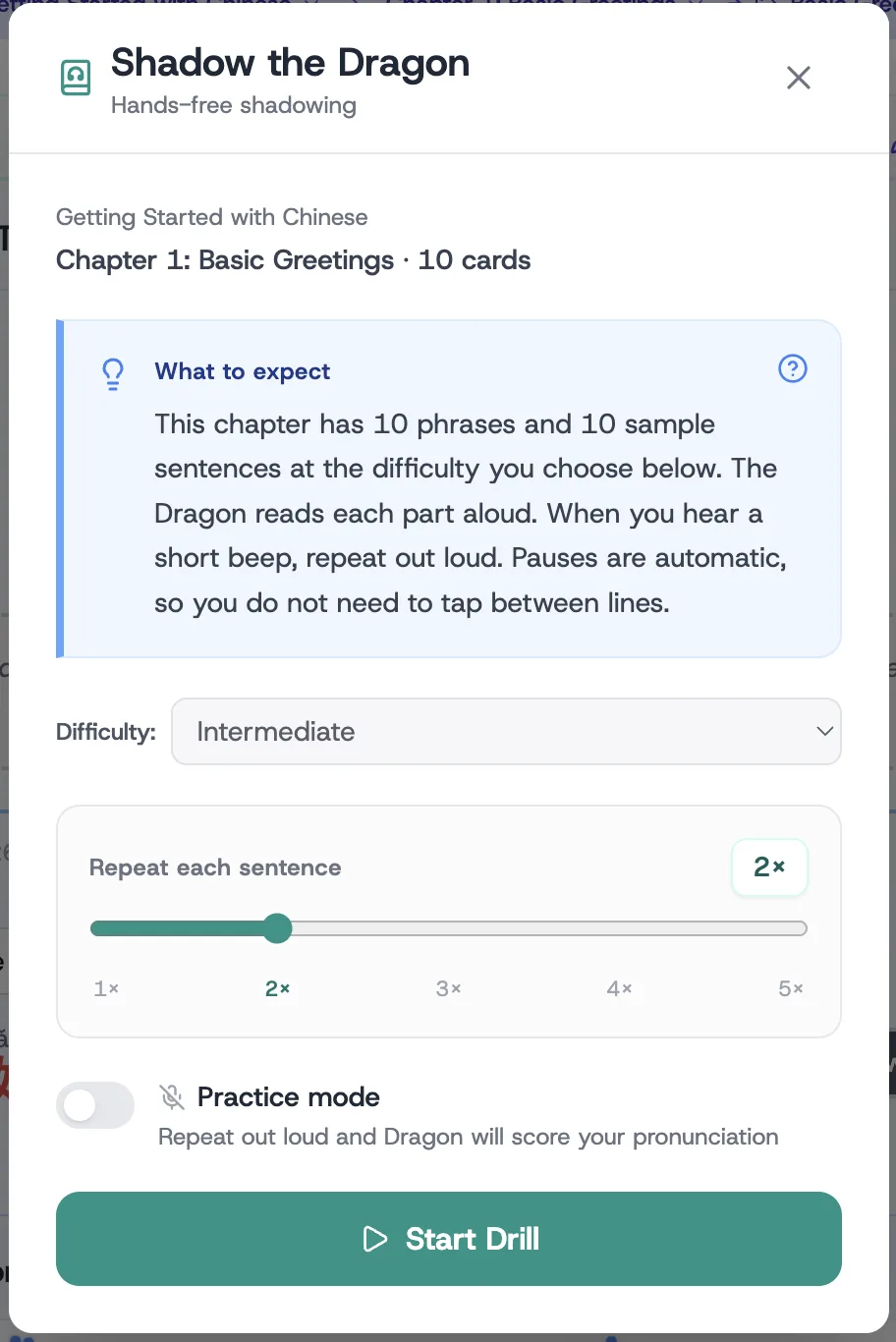
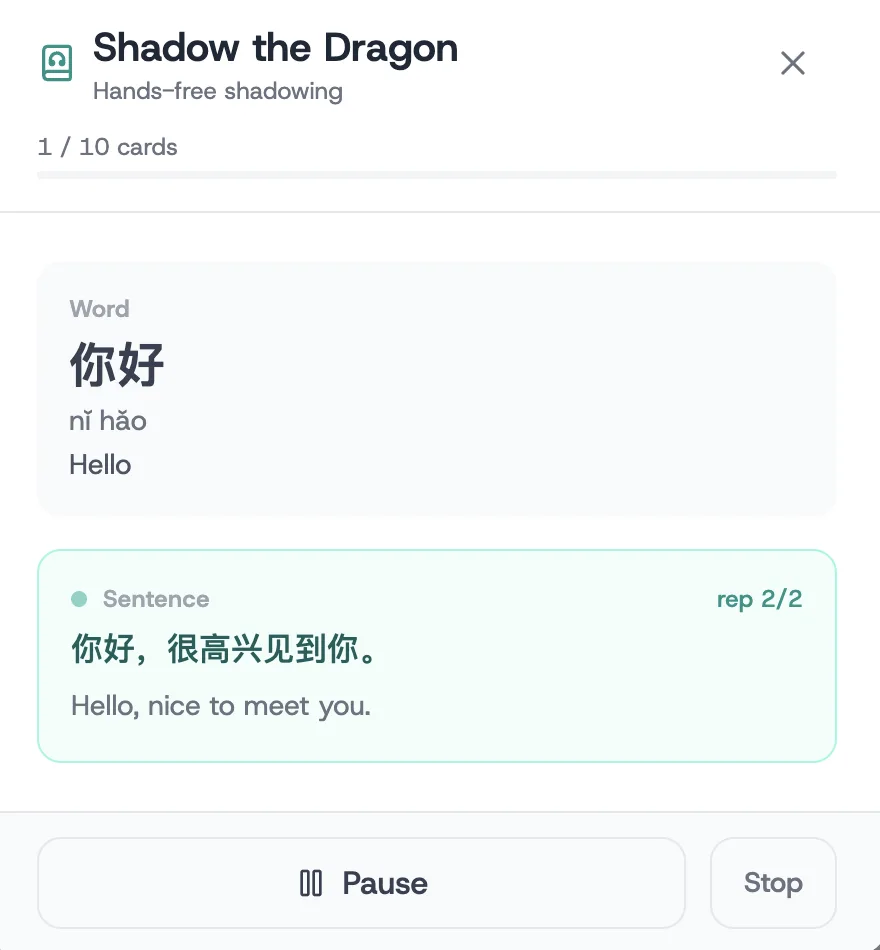
The Shadow the Dragon game is designed for this stage. Audio plays, you shadow it, your pronunciation is scored. The game is hands-free by design. You can do it while commuting, walking, or doing anything that does not require your eyes. Ten minutes on a commute beats ten minutes at a desk for this specifically, because removing the option to look something up forces you to stay in the audio.
What to Shadow
The material matters. Too easy and there is nothing to stretch toward. Too hard and you are guessing rather than shadowing.
The right level for shadowing is slightly above your comfortable reading level. You should recognise most words but not all of them. The unfamiliar ones are where the training is. You shadow the sound without knowing the meaning, and the meaning follows.
For beginners, short sentences with clear pronunciation. For intermediate learners, full paragraphs from graded stories. For advanced learners, unscripted speech: interviews, podcasts, anything without a script, where the rhythm and hesitations of real spoken Chinese are present. The Journey to the West, Chapter 1 is a Master Dragon level example: classical Chinese, dense vocabulary, no handholding.
Start with material you have already read once. The first pass gives you comprehension. The second pass, with shadowing, gives you production. The description of the Condor Heroes Wuxia story is a good starting point: Beginner level, short sentences, clear pronunciation, karaoke mode ready.
Closing the Feedback Loop
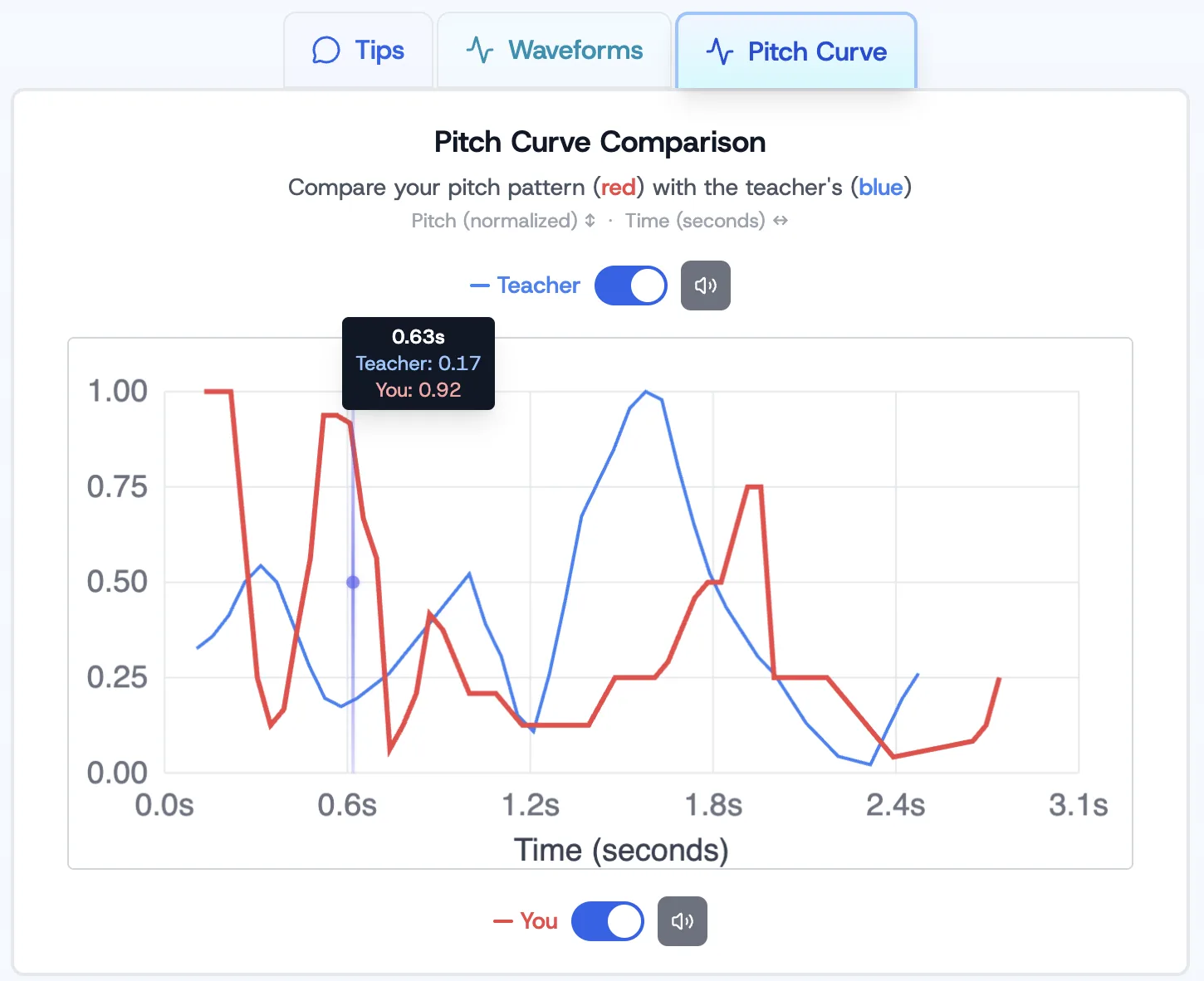
Shadowing without feedback is better than not shadowing. But knowing whether your pitch curve matched the model is what separates practice from improvement. The pronunciation trainer shows you both waveforms side by side: your attempt in red, the teacher in blue. You can see exactly where your tone rose too early or fell too flat.
The Mistake Most People Make
Shadowing at too slow a speed. If you slow the audio down to make it easier to follow, you are training yourself to speak at an unnatural pace and losing the connected speech patterns that make shadowing valuable.
Start at full speed. Fall behind. Get lost. Start the sentence again. Getting lost and recovering is part of the practice, not a sign that it is not working.
The other mistake: stopping to correct yourself. Shadowing is not about perfection on each attempt. It is about keeping your mouth moving in sync with native speech over and over until the patterns are automatic. Self-correction mid-sentence breaks the flow and defeats the purpose. Finish the sentence, then do it again.
Frequently Asked Questions
What is the shadowing technique?
Shadowing is a language learning method where you speak simultaneously with a native speaker recording, matching rhythm, speed, and intonation in real time. Unlike repetition, where you wait for the speaker to finish before responding, shadowing keeps your mouth moving continuously alongside the audio. It was developed and named by linguist Alexander Arguelles.
Does shadowing work for Chinese?
Yes, and it works better for Mandarin than for most languages. Tones are physical contours. You need to feel them in your mouth, not just hear them with your ear. Shadowing forces you to produce tones in real time at natural speed, which passive listening cannot do. Connected speech patterns like tone sandhi also only become automatic through production, not study.
How long should I shadow each day?
Ten to fifteen minutes of focused shadowing beats an hour of passive listening. Short daily sessions work better than long occasional ones. The muscle memory needs repetition over days, not a single long sitting.
What is the difference between read-along and shadowing?
Read-along means speaking simultaneously with audio while reading the text. You have visual support, so the pressure is lower. Shadowing means speaking 1-2 seconds behind the audio with no text, working from sound alone. One has a safety net. The other does not.
Hidden Dragon has both stages built in. Start with a graded story in read-along mode, then move to Shadow the Dragon for hands-free shadowing with pronunciation scoring. No account required to explore the story library.
Hero photo by Leo Visions on Unsplash.