

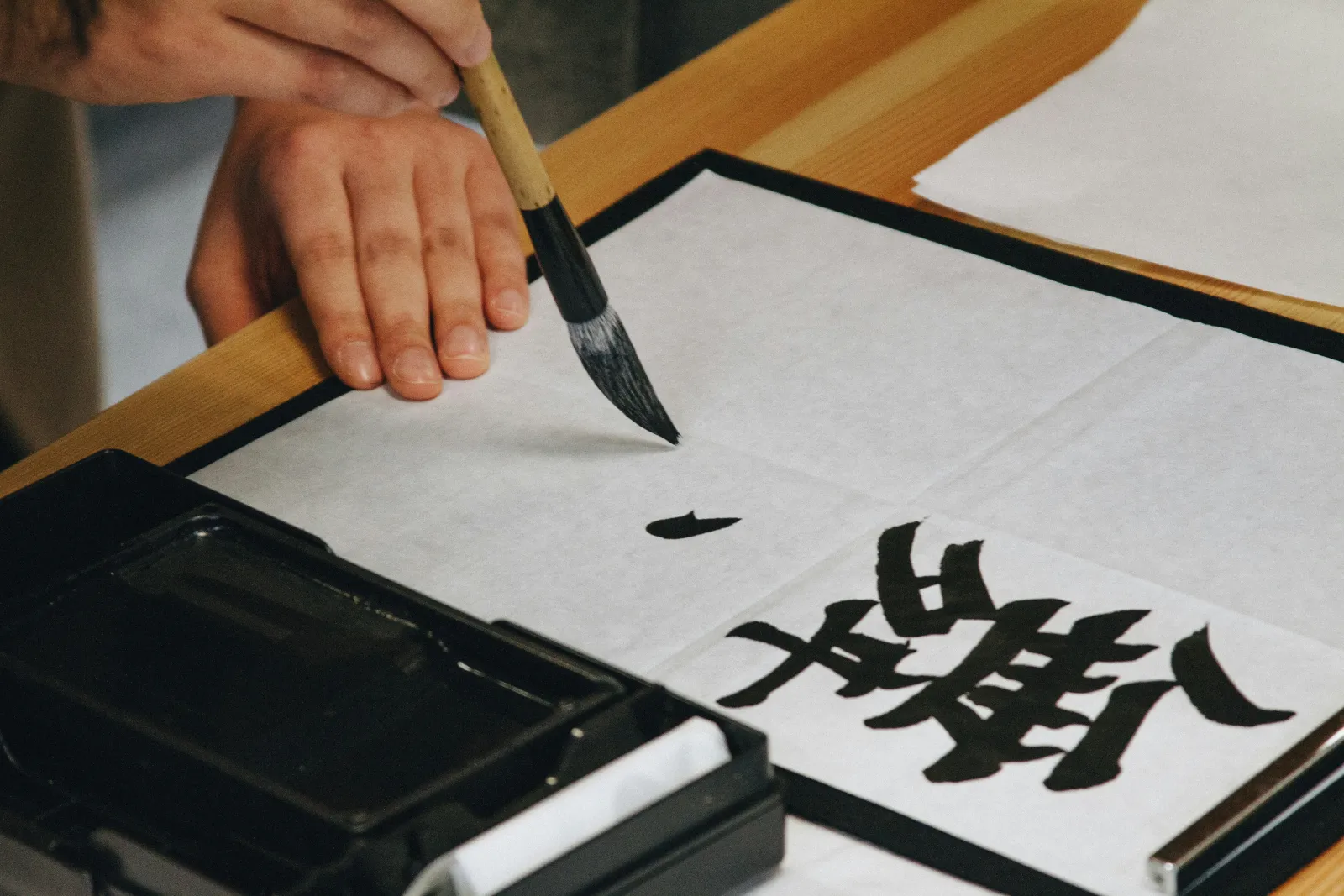
Your phone can show you stroke order. Every modern Chinese writing app does it well enough that the animation itself is a solved problem. What your phone almost never shows you is the structure inside the character: which pieces it is built from, which one carries the meaning, which one carries the sound, and how the shape encodes the idea. That is the lesson that makes characters stick, and it starts with one word that almost no app uses out loud.
What Is Character Decomposition (And Why You Should Care)
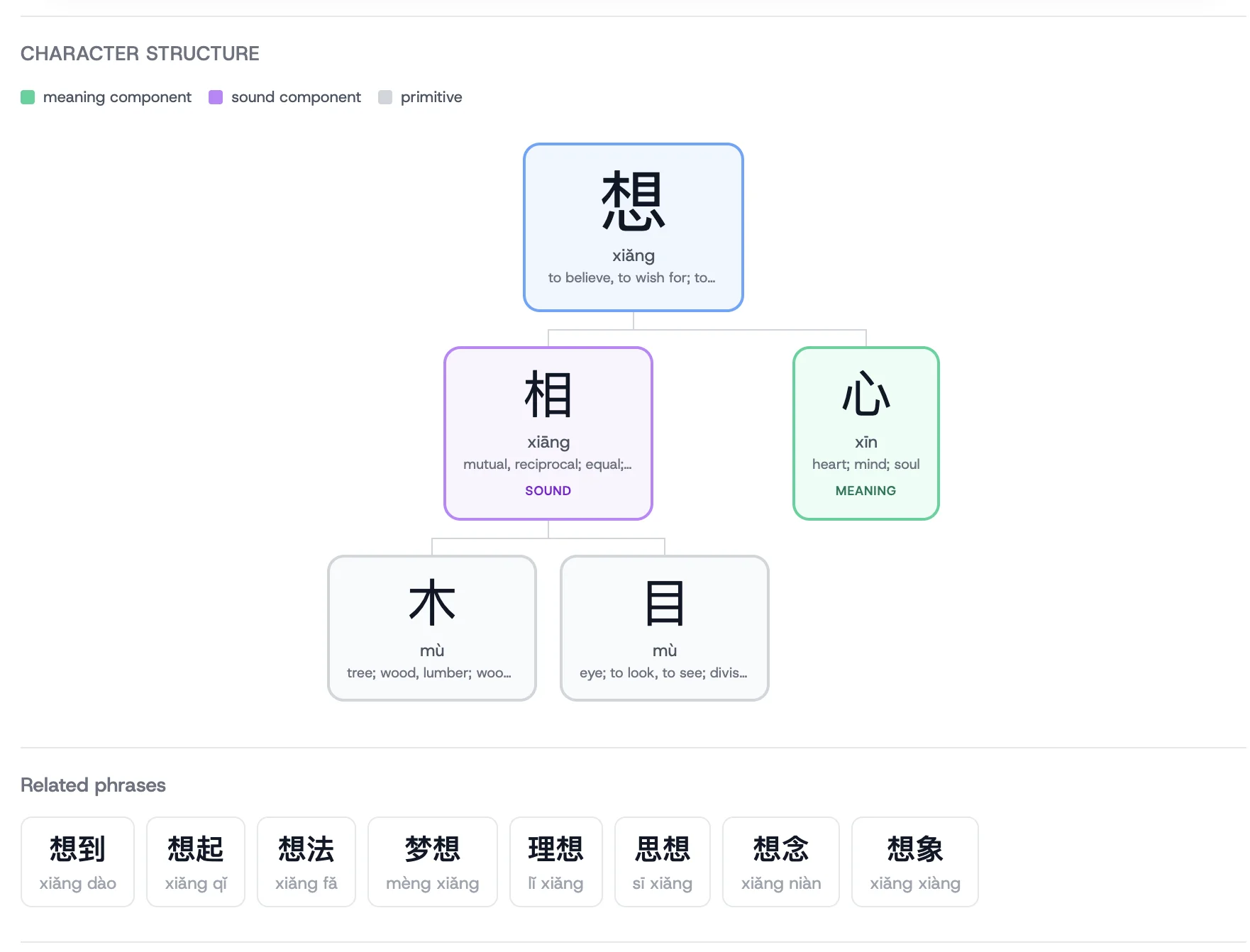
Most Chinese characters are not arbitrary squiggles. They are combinations of smaller pieces, and almost every one of those pieces is itself a character or a recognised radical. 想 is built from 相 on top of 心. 相 is built from 木 next to 目. 心 is the heart radical. The character is not a flat picture. It is a small structure with three parts, each carrying either meaning or sound.
This matters because the brain does not store 2,000 unrelated images well. It stores combinations of components extremely well. A learner who has internalised the top 200 components can read a new character structurally on first sight, even if they have never met it before. A learner who has not is stuck trying to memorise pixel patterns, and that strategy collapses around HSK 3.
Stroke order animation, by itself, does not teach this. It teaches the order your hand moves. The structure underneath, the why of the character, is a different lesson, and most Chinese learning apps leave it out.
Stroke Names, Spoken Out Loud
Open the Write tab on any Chinese character and the stroke order animation works the way you would expect: each stroke draws in the correct sequence, you follow along on the canvas, the app checks whether you traced it correctly. The unusual part is what happens when you tap any individual stroke. A voice speaks its Chinese name aloud. 横 (héng, horizontal). 竖 (shù, vertical). 撇 (piě, falling-left). 捺 (nà, falling-right). 点 (diǎn, dot). 钩 (gōu, hook).
These names are how Chinese teachers have referred to strokes for the entire history of the language. Calligraphy textbooks talk in stroke names. Native primary schoolers learn them at age six. Most Chinese writing apps for foreign learners leave them out entirely, which means a learner can finish HSK 4 without ever hearing the word 撇 spoken.
Click stroke three of 谢 and a voice tells you it is a 撇. You build a vocabulary your hand can follow.
When You Get a Stroke Wrong, You Get Tutored
The other gap in most apps: you trace a stroke incorrectly and the app says "try again". That is not teaching. It is testing.
The Write tab tutors instead, and the help escalates with each mistake.
- First mistake: "Not quite. Try stroke 4 again." Mild correction. Most learners self-correct here.
- Second mistake: the stroke name and pinyin appear, spoken aloud. "Stroke 4: 撇 (piě)." Now you know what kind of stroke you are aiming for.
- Third mistake: the full hint, with the visual description, also spoken. "撇 (piě). Draw a diagonal slash from top-right to bottom-left."
- Fourth mistake and beyond: the app points you to the animation button so you can watch the stroke being drawn correctly before retrying.
This is the staircase of help that a human tutor gives. Mild prompt, then technical hint, then explanation, then demonstration. Built into the quiz instead of replaced by a "skip" button.
The Hints Panel Is Where the Real Lesson Lives
The animation and the quiz are the practice. The hints panel is the lesson. Each character has a structured panel with seven sections, every one of which is the kind of thing a serious textbook would give you and almost no app does.
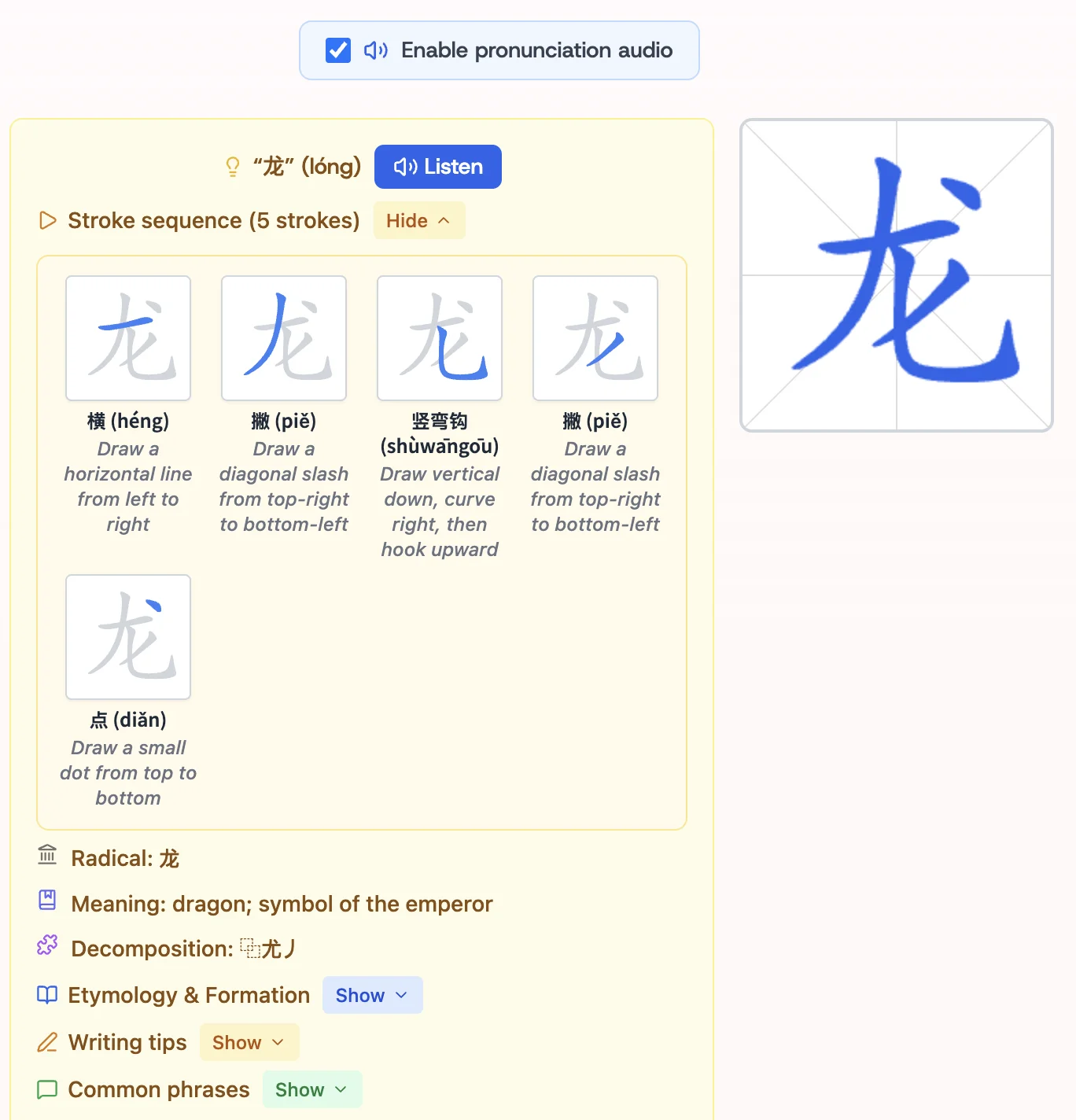
- Stroke sequence. Numbered list of every stroke with its name. The vocabulary your hand needs.
- Basic info. The character's radical, pinyin, and meaning. The radical is the indexing piece every Chinese dictionary is sorted by, and knowing it is the difference between looking a character up in three seconds and giving up.
- Decomposition. What components the character is built from. Once you can read characters as combinations of pieces instead of flat pictures, every new one you meet is half-decoded before you start. 想 decomposes into 相 and 心. 谢 decomposes into 讠 + 身 + 寸.
- Etymology and formation. Why the character looks the way it does. Pictograph, ideograph, phono-semantic compound. For phono-semantic characters, which piece carries the meaning and which carries the sound. Etymology is the single biggest unlock for adult learners and almost no Chinese learning app surfaces it.
- Phonetic family. Other characters that share the sound component. 相, 想, 箱, 厢 all share 相 as their sound piece, which is why they all sound something like xiang. Once you can read the family, the next character you meet from it tells you both how to pronounce it and roughly where in the language it lives.
- Writing tips. Common mistakes and stroke order rules specific to this character.
- Common phrases. The high-frequency words this character appears in, with pinyin and translations.
You are not learning a character. You are learning a system. The sections build on each other so that the hundredth character you study is easier than the first, not harder.
The Composition Tree
The decomposition section answers "what is this character made of". The composition tree shows it. Open the Write tab and switch to the Composition subtab.
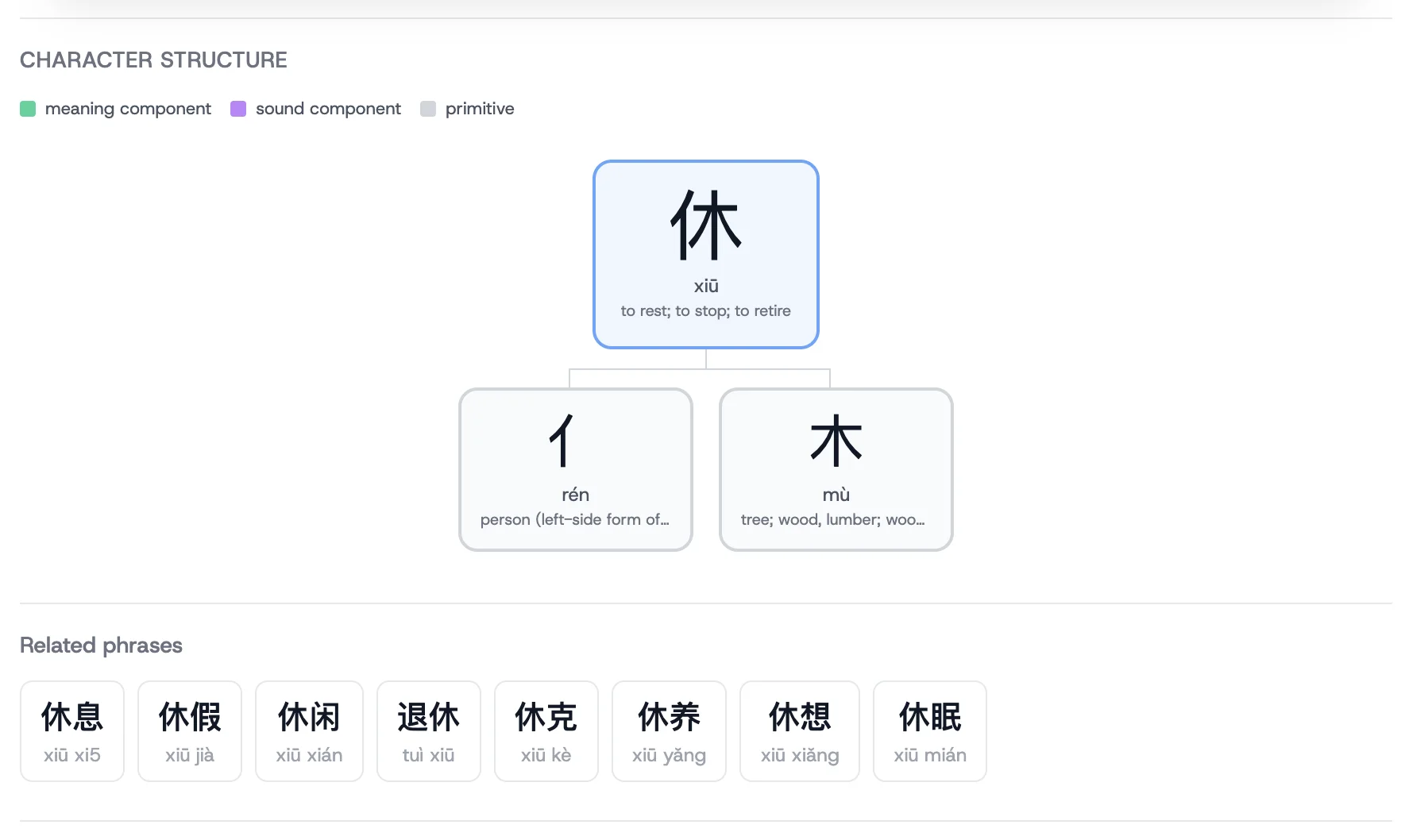
For a simple compound like 休, the tree is two boxes under the parent: a 人 (person) standing next to a 木 (tree). That is rest. A person leaning against a tree. The character looks the way it looks because the meaning is built into the shape.
For a phono-semantic compound like 想, the tree has three boxes under the parent. 相 is the sound piece, coloured purple. 心 (heart) is the meaning piece, coloured green. And 相 itself decomposes one level deeper into 木 + 目. You read the tree top-down and the character makes sense: think with the heart, sounds like 相.
For a deeper character like 赢, the tree expands across multiple levels. 亡, 口, 月, 贝, 凡, and the components inside 凡 itself. Hover any node and a panel shows pinyin, definition, HSK level, and a play button for the audio. This is what every serious Chinese teacher draws on a whiteboard when they explain a complex character.
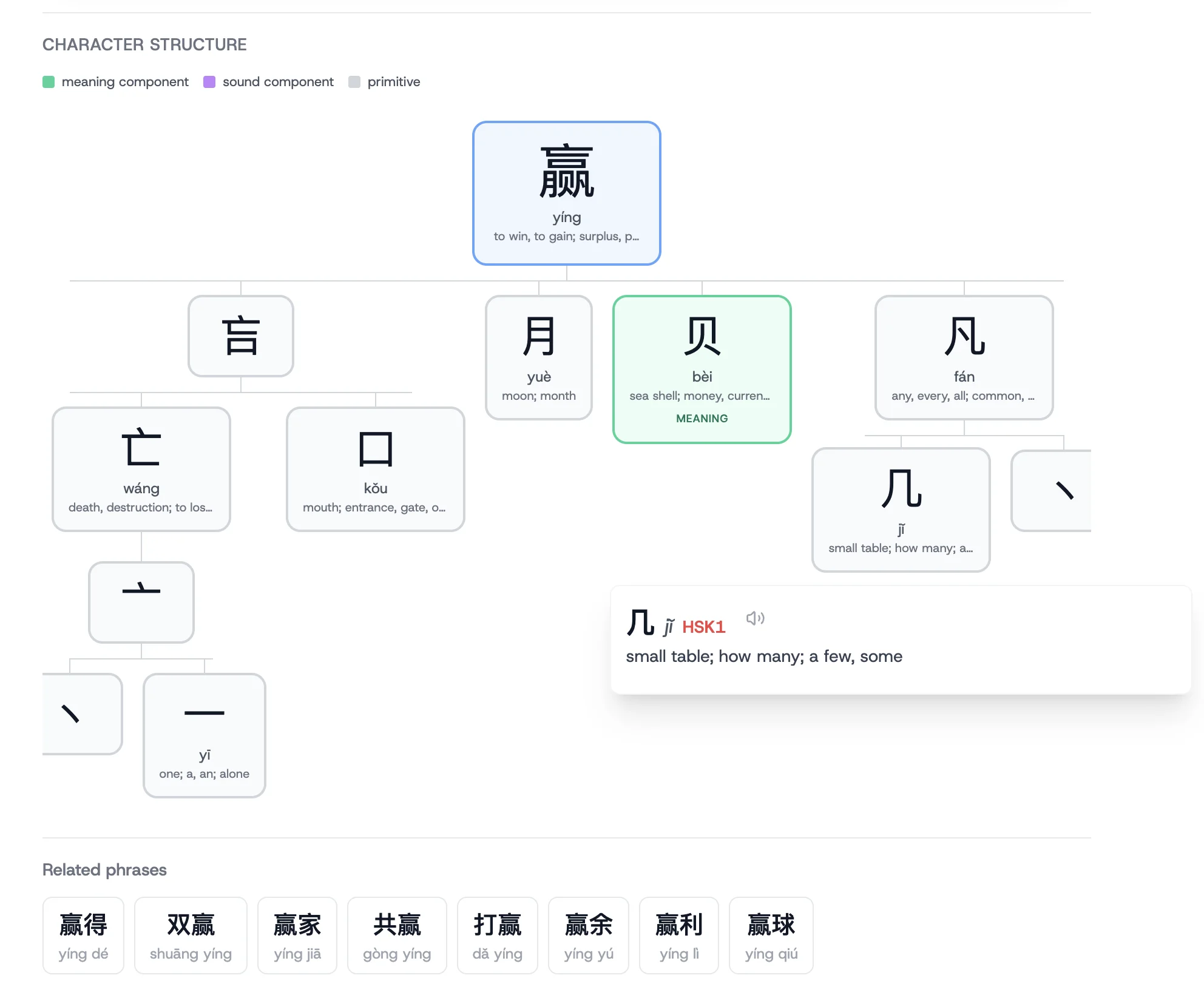
The tree is built from the open-source CJK ideographic description data, the same data linguists use to study Chinese character formation. Most apps never expose it. We made it the second tab on the Write panel because the structural understanding is what makes characters stick.
Try It
Open the demo card for 龙. Trace a few strokes. Click an individual stroke to hear its Chinese name. Get one wrong on purpose to see the tutoring escalate. Then switch to the Composition subtab and see how the character decomposes. The whole flow is open without an account.
If you want a character that shows the decomposition power off, try 赢 or 谢. For a character with a textbook phono-semantic structure, try 想.
Frequently Asked Questions
What is character decomposition and why does it matter?
Chinese character decomposition is breaking a character into the smaller components it is built from. Most characters are not arbitrary shapes. They are combinations of two or three pieces, each of which carries either meaning or sound. Once you can see 想 as 相 (sound) plus 心 (meaning, "heart"), you stop trying to memorise it as a flat picture and start reading it as a structure. The composition tree shows the decomposition visually for every Chinese character in the app.
Does this teach Chinese radicals?
Yes. Every character's hint panel lists its radical, and the composition tree colours meaning components (typically the radical) green so you can see at a glance which piece is doing the semantic work. Around 200 radicals cover the vast majority of Chinese characters, so learning to read the tree is also learning the radical system.
Do I need an account?
No. The Write tab is fully usable without signing up, on any character you can reach through the demo URL. Saving progress and tracking your stroke accuracy over time requires login, but the practice itself does not.
Is this just hanzi-writer with extra steps?
The base stroke animation uses hanzi-writer, the open-source library most serious Chinese apps build on. The animation itself is not where the work went. The work is everything around it: spoken stroke names, the progressive tutoring, the seven-section hints panel, and the composition tree.
What about handwriting recognition?
The quiz checks your stroke path against the correct stroke. It is not OCR. You do not have to draw a perfect-looking character to pass. You have to draw the correct stroke in the correct direction at roughly the correct location. That is what builds the muscle memory.
Does this work for traditional characters?
Yes. If your card has a traditional variant, you can toggle it and the Write tab renders the traditional form with its own stroke order, decomposition, and composition tree.
If you want the broader case for why writing characters by hand is fundamentally different from recognising them, read How to Learn Chinese Characters, Not Just Recognise Them. For the other half of the "characters that trip you up" problem, the Confusables game is what trains you on the visual near-twins like 己, 已, 巳.
Hero photo by Niky V on Unsplash.