


Tap any word in a Japanese sentence. Get the kanji, the kana reading, the romaji, the JLPT level, and the meaning, in one panel. Tap a kanji inside that word and get its on'yomi, kun'yomi, radical, decomposition, and stroke order. Every word in front of you is one tap away from a complete explanation.
Hidden Dragon now teaches Japanese. (New to Hidden Dragon? Start here.)
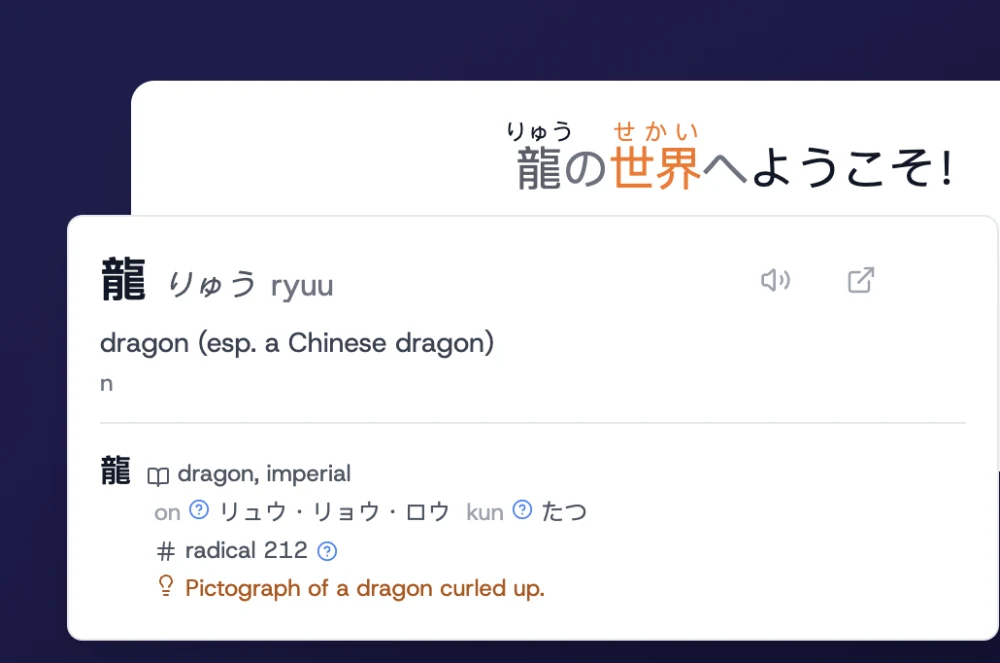
What you get when you tap a Japanese word
Open a Japanese card and tap any word in the sentence. A panel slides in with everything we know:
The kanji and the reading together. 学校 with がっこう right next to it. No guessing whether you should be pronouncing it the on-yomi way or the kun-yomi way for this particular word. We show you which reading is correct in this context.
Romaji underneath the kana. がっこう gakkō. If you have not memorised hiragana yet, you can still pronounce the word. If you have, you can ignore the romaji. Both audiences served.
The JLPT level. A small N5, N4, N3, N2, or N1 badge tells you exactly how foundational this word is. The colour scheme parallels HSK: warmer for easier, cooler for harder. If you transferred from Chinese, the visual intuition transfers with you.
The meaning. Sourced from JMdict, the public-domain Japanese-English dictionary maintained by the Electronic Dictionary Research and Development Group. Over 200,000 entries.
The grammar role for particles. Tap は in 私は学生です and you do not get a confusing dictionary entry. You get a curated explanation: "Topic marker. Pronounced 'wa', not 'ha'. Marks what the sentence is about." Same for が, を, に, で, へ, から, まで, より, の, も. The most common particles in Japanese, each with a beginner-friendly explainer that takes one tap.
What makes Japanese different from Chinese
A few things needed new infrastructure.
Kanji can have multiple forms. 竜 and 龍 are both valid spellings for "dragon". Modern Japanese mostly uses 竜, but 龍 still appears in names, traditional contexts, and pre-war texts. Tap either one and you get the same dictionary entry. We index every kanji form JMdict carries, not just the primary one. About 54,000 alternate forms across the JMdict corpus, all reachable.
Kanji carry hidden information that pinyin cannot. When you tap a kanji-containing word, you also see the kanji's radical, its on-yomi readings, its kun-yomi readings, and its individual meanings. 学 (learn) has on-yomi ガク and meanings "study, learning, science". This data comes from KanjiDic2 and is not the same as the word lookup. It is a layer beneath, exposing the etymology and structure of each kanji you are reading. Click a kanji while it is highlighted and you see its components.
There is no equivalent of pinyin on the kanji side. For Chinese learners, the surface form already includes pronunciation cues if you know the character. For Japanese, the kanji 行 could read iku, okonau, or gyō depending on context. We resolve which one is correct for the word you tapped, and show that reading both in kana and in romaji.
Particles are grammar, not vocabulary. A dictionary lookup of は returns "leaf" (because は is also a kun-yomi reading of 葉). That is unhelpful. We use the morphological tokenizer's part-of-speech tag to detect when は is acting as a particle and route to a curated grammar note instead. The disambiguation is automatic.
JLPT-graded Japanese sample sentences from Tatoeba
Every word card in Japanese now includes example sentences from the Tatoeba project, filtered down to the cleanest pairs and graded by difficulty.
The grading uses the kanji's JLPT level. A sentence built entirely of N5 kanji lands in Beginner. Add an N4 kanji and it shifts to Intermediate. The hardest kanji in the sentence determines the bucket. Pure-kana sentences are Baby Dragon, the easiest level. Sentences with kanji we cannot place on the JLPT scale are Master Dragon, the hardest.
This is the same Dragon difficulty system you already know from Chinese cards. Beginner, Intermediate, Advanced, Master Dragon, plus Baby Dragon for the easiest material.
Kanji stroke order, kana stroke order, all in the Write tab
Open the Write tab on any Japanese card and you get the same teaching surface Chinese learners use for hanzi: a stroke-order canvas that animates the character one stroke at a time, plus freeform drawing practice that scores each stroke as you write it.
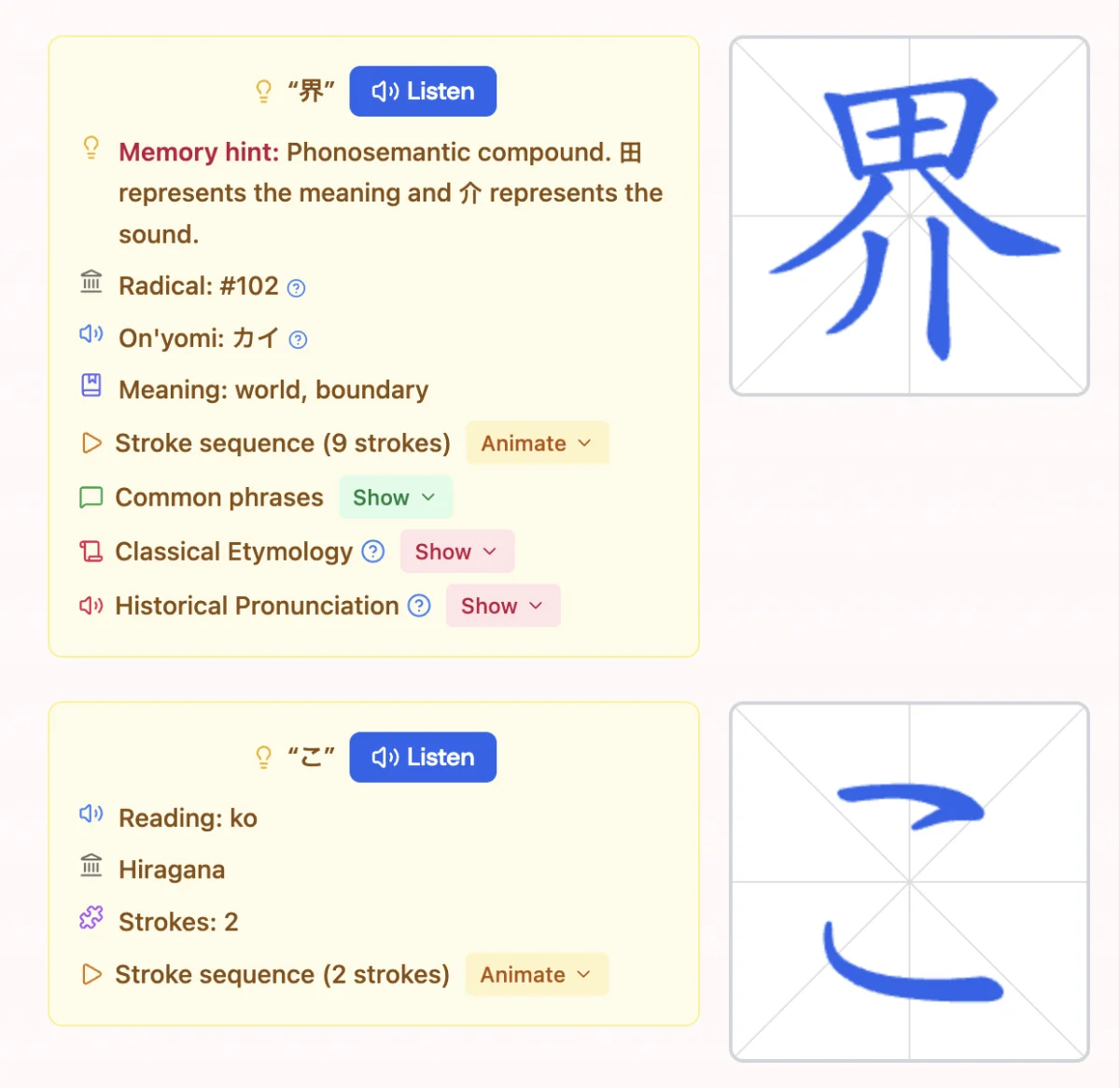
Tap any character. Click Animate. The stroke order plays. Click a thumbnail in the per-stroke grid to see exactly which stroke is which. KanjiVG drives the data for kanji, AnimCJK drives the same for hiragana and katakana, so absolute beginners can use Animate to learn how to write あ, and intermediate learners can use it to refresh on a kanji they have not seen in months.
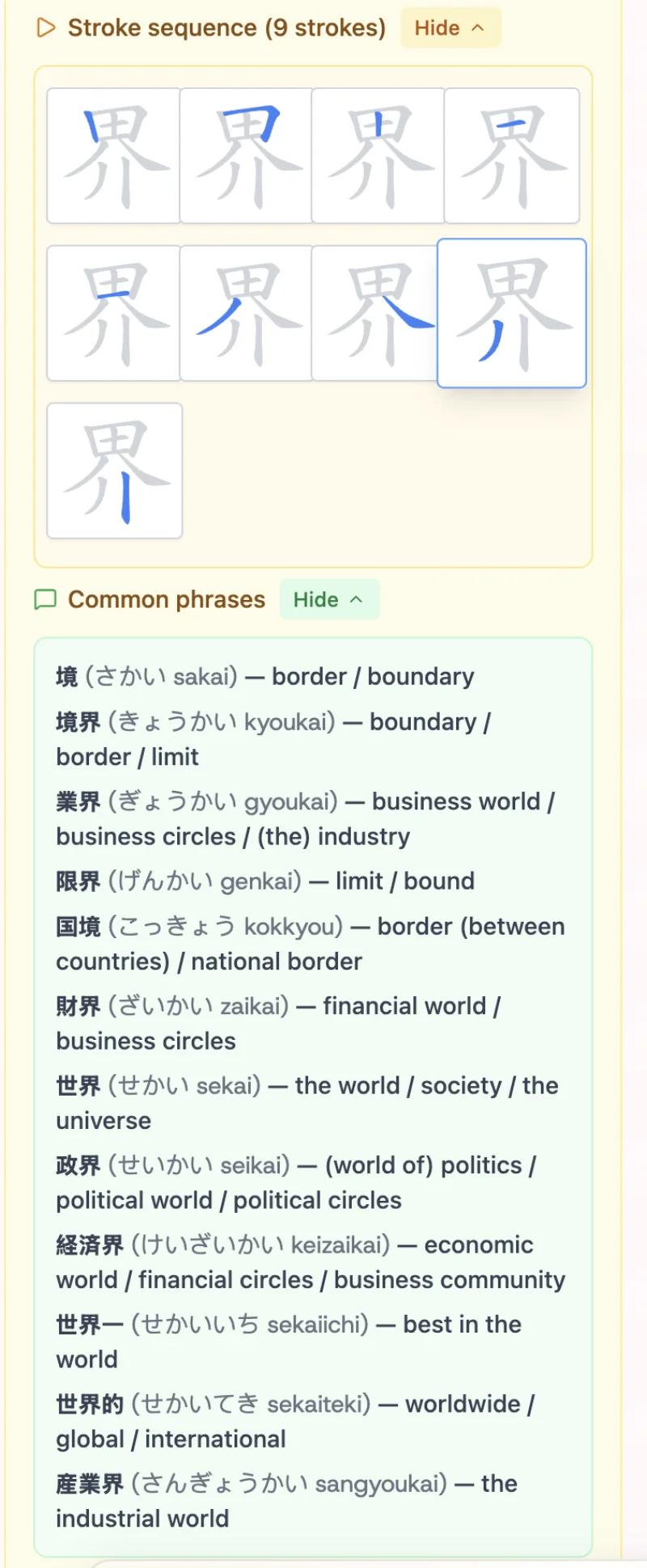
Underneath the writing surface is real spaced repetition. The SM-2 algorithm, the same one Anki and SuperMemo use, drives review scheduling per character. Mistake tracking through HanziWriter feeds the SRS, so the kanji you struggle with come back sooner. Draw, get scored, miss, review, drill again. The loop dedicated kanji writers will recognize.
The hint data shifts language to language without rewriting the panel. KanjiDic2 supplies on'yomi, kun'yomi, radical, and JLPT level for kanji. JMdict supplies the compound list (the "Common phrases" section above). Composition decomposition works because the underlying CJKVI Ideographic Description Sequences cover both Han block sets.
Writing practice, the JLPT-graded reader, the word panel, sample sentences, and stroke animation all live on the permanent free tier. No trial timer, no eventual paywall on those features. Pro adds AI-driven layers on top: story generation, conversational tutoring, homework grading, exam grading, and Mandarin pronunciation scoring.
Writing Practice
Pick a kanji. Animate the strokes. Switch to Start Practice and write each stroke yourself. Hidden Dragon scores you stroke-by-stroke. Misses feed an SM-2 SRS schedule that brings the kanji you struggle with back sooner. Mnemonics come from KanjiDic2 for the structural data (radical, on-yomi, kun-yomi, JLPT level) and Dong Chinese for the memory hook ("phonosemantic compound, X represents the meaning, Y represents the sound"). Kanji ARE Chinese characters historically, so Dong's etymology transfers directly.
What else does Hidden Dragon give you:
- Tap-to-define on any Japanese text. Paste a news article, a song lyric, a card you imported, anything. Every word is one tap from a JMdict entry.
- JLPT-graded reading. Tatoeba sentences colour-coded by JLPT difficulty, with karaoke playback. Drill writing in the morning, read graded prose in the evening, same app.
- Phonosemantic decomposition tree. Open the structure of a kanji and see why it is pronounced the way it is. Meaning component on one branch, sound component on another.
- Dragon AI tutor for conversation, homework, and exam grading. Pro-only.
- Free tier covers writing, reading, decomposition, and the dictionary. Pro adds SRS for writing practice.
Furigana, JLPT colours, and karaoke playback in the reader
Kana ruby renders above kanji inline, the way most beginner Japanese textbooks do it. There is a Furigana toggle in the reader bar so learners past the early levels can switch it off. JLPT colours layer cleanly underneath the ruby. Press play and a karaoke highlight tracks the active sentence as the audio plays, so the eye finds where it is even when the prose is unfamiliar.
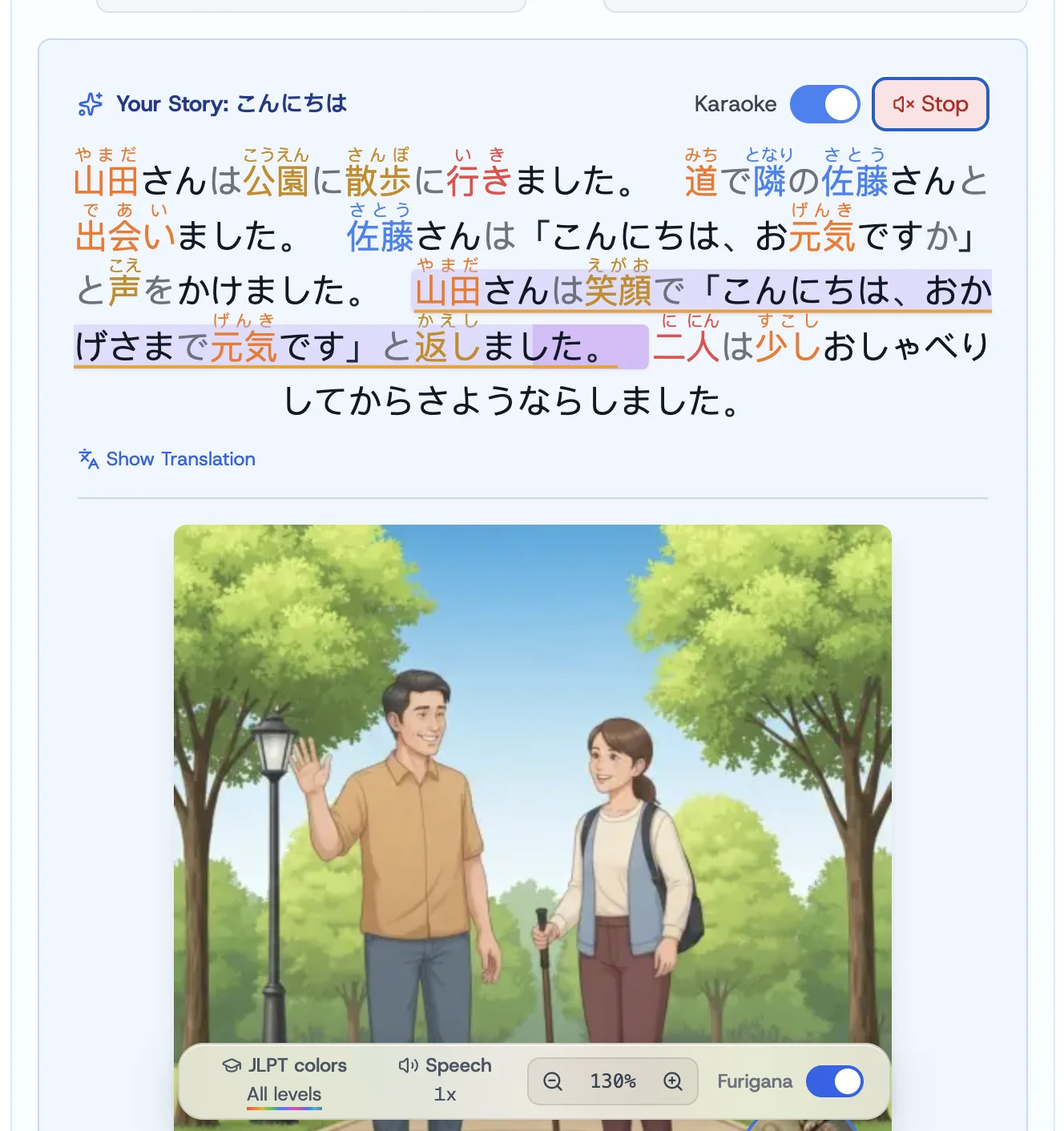
Three layers in one frame: the colour tells you how hard each word is, the ruby tells you how to read each kanji, and the karaoke band tells you where you are in the sentence. None of them obscure the others. You can toggle each independently from the reader bar.
Kanji aren't random and composition shows you why
The Write tab on a kanji card has a Decomposition view. Open it and the kanji breaks down into its components, recursively, showing which parts contribute meaning and which contribute sound.
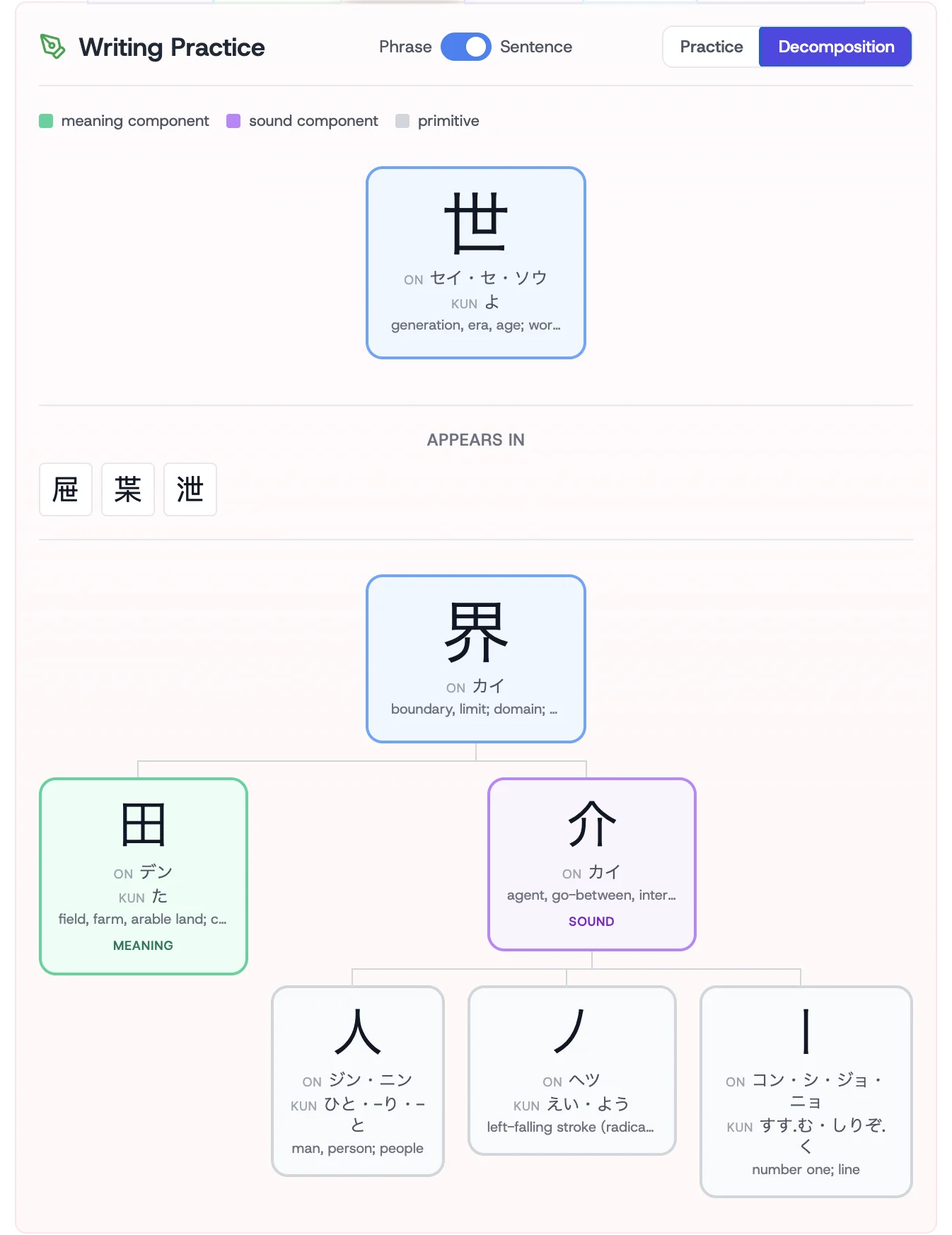
Look at the readings. 界 is read kai. Its sound component, 介, is also kai. That's not coincidence. Most kanji are phonosemantic compounds: one part tells you what the kanji means, another part tells you how it's pronounced. About 80% of kanji are built this way once you know where to look. The composition view exposes the seam.
This is something you can read off a single kanji. There's no separate explainer to find, no chart to consult. Open Decomposition, see the structure, see the readings, see the relationship.
Public per-kanji landing pages
Every kanji has a public landing page. /dict/jp/学 works. It's the same surface a logged-in learner sees — stroke order, on'yomi/kun'yomi, JMdict compounds, the composition tree — but no auth required. Share a kanji link with a friend, embed one in a study log, link to one from a forum thread. The curated entry point is /chars/jp: 178 JLPT N5 kanji and words grouped by theme (Numbers, Family, Food & Drink, Places, Common Verbs, Common Adjectives), plus a free-text input for any kanji not in the starter set.
What should we build next?
We have ideas. We would rather hear yours.
Pitch accent practice. Japanese pronunciation has more to it than the kana spelling suggests. Mora-timed cadence and pitch contour are what make a Japanese sentence sound Japanese rather than English-with-Japanese-words. A dedicated drill surface for pitch is on our shortlist.
Pronunciation scoring for Japanese. Azure Speech supports ja-JP, and the scoring plumbing is already there for Chinese. Calibration is real work, similar to what the Chinese feature went through.
JLPT curriculum tracks. Drop-in vocabulary lists for N5 through N1, layered on top of the same card import pipeline that already handles the data shape.
Particle drill mode. Kuromoji's part-of-speech tags can programmatically generate quizzes for は / が / を / に / へ / で / と confusion from any Japanese sentence on the platform.
Verb conjugation engine. Recognition (kuromoji's conjugated_form field) is free; generation (dict form to te-form, plain to keigo, etc.) is a small library away.
Pre-war kanji coverage. A curated 學 → 学 alias map covering kyūjitai forms not in JMdict, so reading classical or pre-war texts has full dictionary support, not just the kanji hint section.
What would you use most? Which of these matters or pitch something we did not list. Real learner pain shapes the roadmap better than our guesses do.