

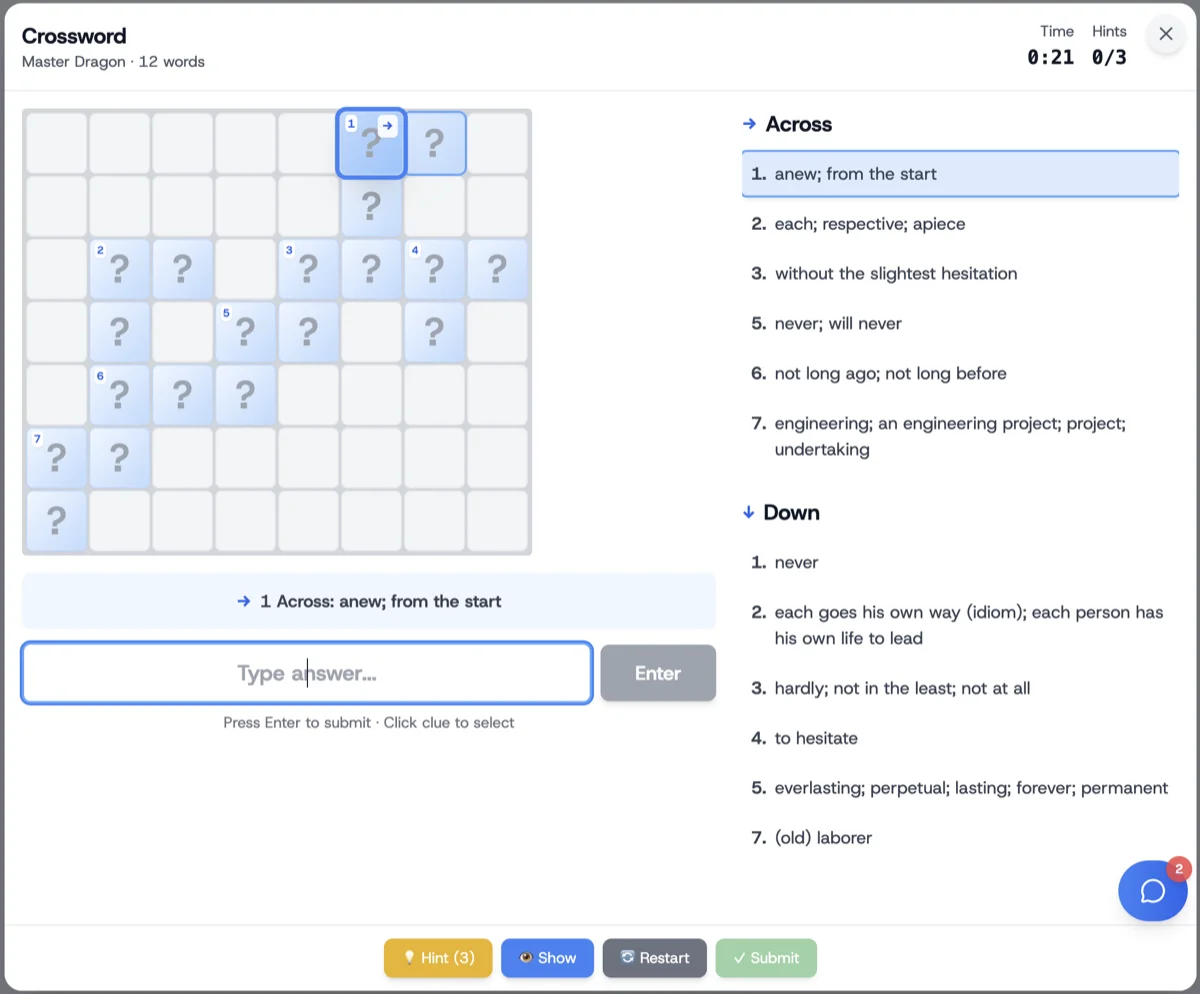
I spent a weekend trying to get AI to generate a Chinese crossword puzzle. I tried GPT-4o, Claude, DeepSeek, Qwen. These are the models that pass HSK and explain idioms. I gave them the same prompt: generate a simple 4-word crossword using HSK 1 vocabulary.
Every single one produced an unsolvable grid.
The characters were there. The clue numbers were there. It looked like a crossword. But when you traced the intersections, they did not align. 1-Across put 人 at position (0,0); 1-Down needed 大 at that same cell. The model placed both, unaware it had contradicted itself. An LLM has no canvas. It cannot check whether the cell at (0,0) is consistent with two words at once.
The narrower problem did not help. Chinese crosswords operate at the character level (thousands of logographs, not 26 letters), with variable word lengths (2-4 characters), and most of the training data an LLM has seen is English crosswords. The model does not know what a Chinese crossword looks like because it has barely seen one.
So I gave up on AI and built an algorithm.
The "Growth Point" Approach
The generator starts with a random word (preferring 4-character idioms like 龙飞凤舞) at the centre of a grid. Then it creates "growth points" at every character. Each one can sprout a new word in the perpendicular direction. It picks growth points randomly from the queue (not in order), which is what creates branching, dense puzzles instead of straight lines.
The algorithm places words, validates every constraint (no parallel adjacency, no overlapping words, everything connected), and trims the grid to fit. It runs in 5-9 milliseconds. It always produces a valid, solvable puzzle. No AI inference cost, no hallucinations, no contradictions.
The generator pulls words from HSK 3.0, indexed by level, and calibrates every puzzle to your target difficulty. For each difficulty tier, it filters vocabulary by HSK level and character length before the algorithm even starts building, so every puzzle only uses words you are likely to have studied.
This means a Baby Dragon puzzle draws exclusively from the ~300 HSK 1-2 words that are exactly 2 characters long. An Advanced puzzle can pull from any of the ~11,000 HSK 1-9 words at any length. The algorithm does not just generate a crossword; it generates one that matches your vocabulary.
Five Difficulty Levels
| Level | Words | Characters | HSK Range |
|---|---|---|---|
| 🐣 Baby Dragon | 4 | 2 only | HSK 1-2 |
| 🌱 Beginner | 5 | 2-3 | HSK 1-3 |
| 🌿 Intermediate | 8 | 2-4 | HSK 1-6 |
| 🌳 Advanced | 10 | 2-4 | HSK 1-9 |
| 🐉 Master Dragon | 12 | 2-4 | HSK 1-9 |
Baby Dragon gives you 2-character HSK 1-2 words. Perfect for absolute beginners. Master Dragon throws the full HSK vocabulary at you in a dense 12-word grid.
How It Plays
Pick a level and the game generates a fresh puzzle on the spot. The grid shows Chinese characters in blue-highlighted cells. English clues sit in a panel on the right. Tap a cell to select it, type the character, and the game auto-advances to the next clue when you are correct. Correct answers trigger a flip animation and the app speaks the word aloud so you hear the pronunciation.
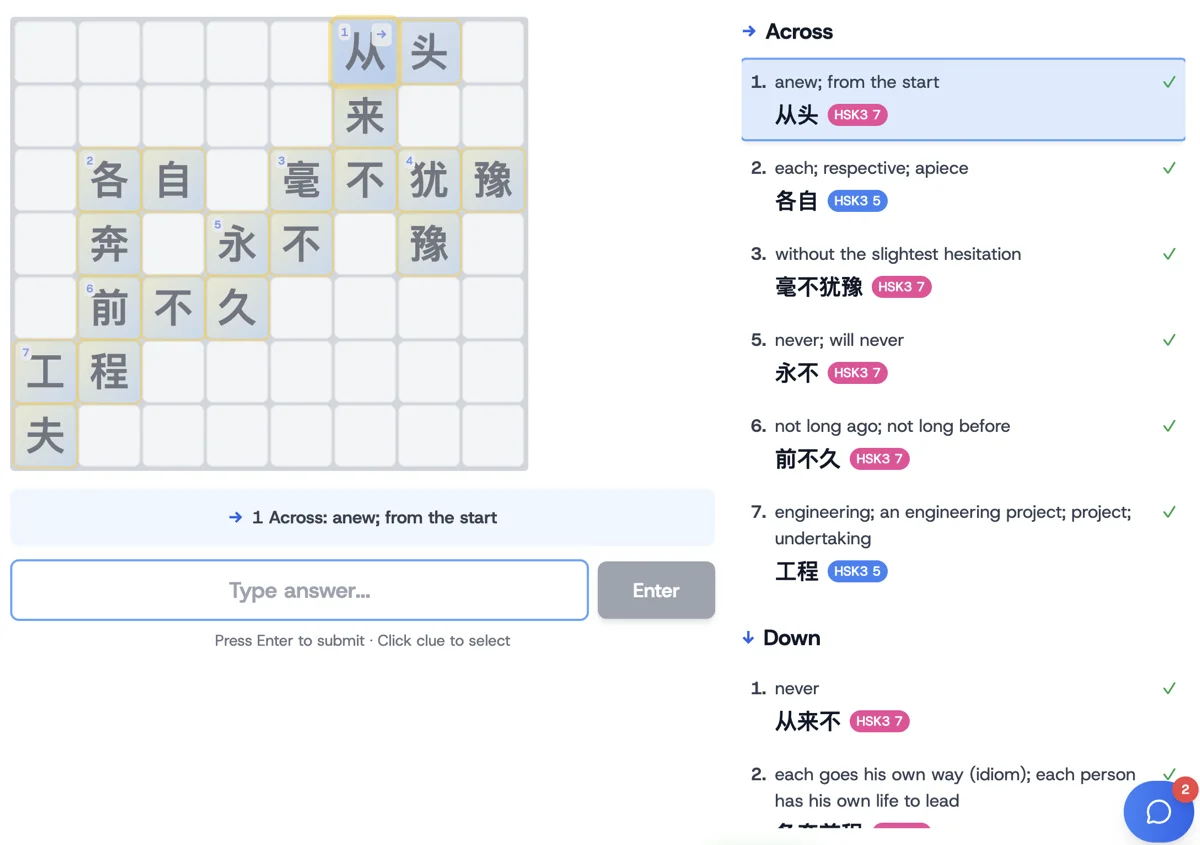
Three hints per game if you get stuck (each reveals one character from the current word). A "Show All" button reveals the entire grid if you want to study the answers. Submit when you are done and the victory screen shows your score, accuracy, time, and XP. It also shows a vocabulary review of the words you struggled with.
The game saves progress to your browser, so closing the tab does not lose your puzzle.
The Hardest Part Was Keeping It Simple
The algorithm was rewritten once. The first version used precomputed compatibility graphs and retry loops. It was slow and over-engineered. The second version (the one in production) is 600 lines, runs a single pass, and produces Excellent puzzles on every attempt. The lesson: constraint satisfaction problems benefit from simple, direct algorithms. AI was a distraction.
To try it, open Hidden Dragon and look for the crossword option in Games. No account needed to play. Not sure which difficulty fits you? The HSK comparison tool shows the vocabulary breakdown across HSK levels so you can pick where to start.
Frequently Asked Questions
Is this AI-generated? No. The puzzle is built by a pure algorithm with no AI involved. The clues come from the HSK vocabulary database. AI is not used in any part of the crossword feature.
Can I play crosswords with my own vocabulary? Currently the crossword uses HSK vocabulary filtered by difficulty. If you want to practise specific words from your chapter, games like Word Rain work from your personal chapter cards.
Are the clues AI-generated? No. The English clues come directly from the HSK vocabulary database using CEDICT-based translations. These are the same exact translations used in flashcards and stories, not generated by AI.