Why Generic English Apps Fall Short for Chinese Speakers
Mandarin speakers learning English face a predictable set of problems. The voiced and unvoiced th do not exist in Mandarin. The English r requires a tongue position no Mandarin sound prepares you for. Word-final consonant clusters (strengths, texts, desks) feel unnatural because Mandarin syllables end in a vowel or nasal. Vowel contrasts like ship vs sheep or full vs fool collapse because Mandarin has far fewer vowel distinctions.
These are not random errors. They follow directly from Mandarin phonology. An app that identifies and corrects exactly these patterns is worth more than one that just tells you to try again.
The Apps
Hidden Dragon
Hidden Dragon combines phoneme-level pronunciation feedback, SRS flashcards, AI conversation scenarios, and illustrated story generation in a single tool. A Chinese speaker learning English uses the same engine that powers our Mandarin courses, just pointing the other direction.
Getting started with English. Open the app, set your target language to English, and you get a starter book with 200 practical English words grouped by topic (greetings, food, travel, work). Each card has native audio, a sentence example, and pronunciation scoring. From there you can generate your own content at any level - no artificial ceiling.
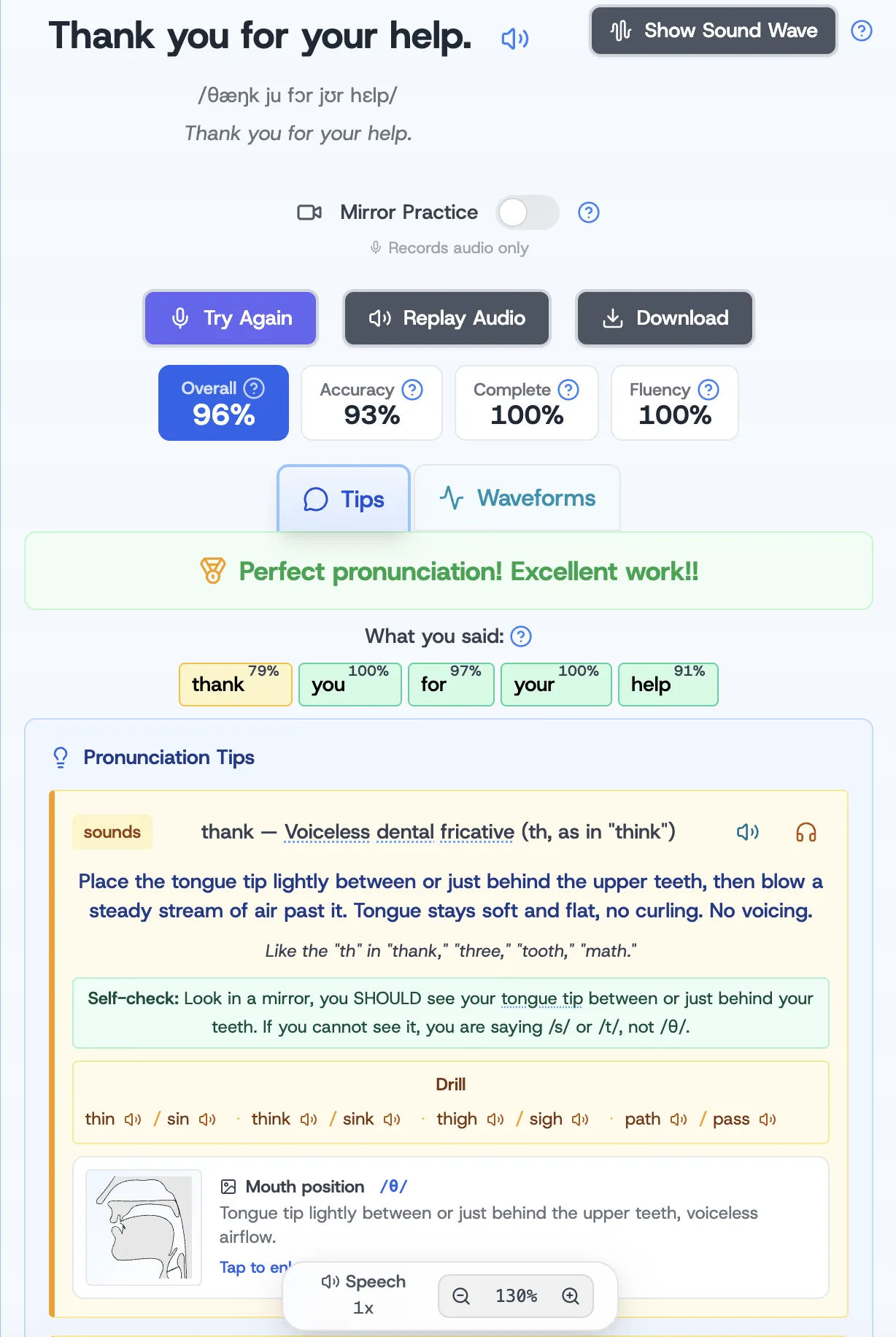
SRS flashcards with pronunciation scoring. Every word you study becomes an SRS (spaced repetition system) card. When you review a card, you score your pronunciation and see phoneme-level feedback. If you are substituting /s/ for /th/, the app tells you specifically, not just "incorrect." A mouth placement diagram shows where your tongue and lips should be. This combination of SRS and pronunciation feedback is unique to Hidden Dragon - no other tool on this list pairs them.
Illustrated story generation. You can generate a graded English story on any topic, illustrated, at your level. A business professional generates a story about contract negotiation. A student generates content around IELTS topics. The story turns into SRS flashcards automatically - you study the vocabulary that matters to you, not a generic word list. Try the sample story above to see what this looks like.
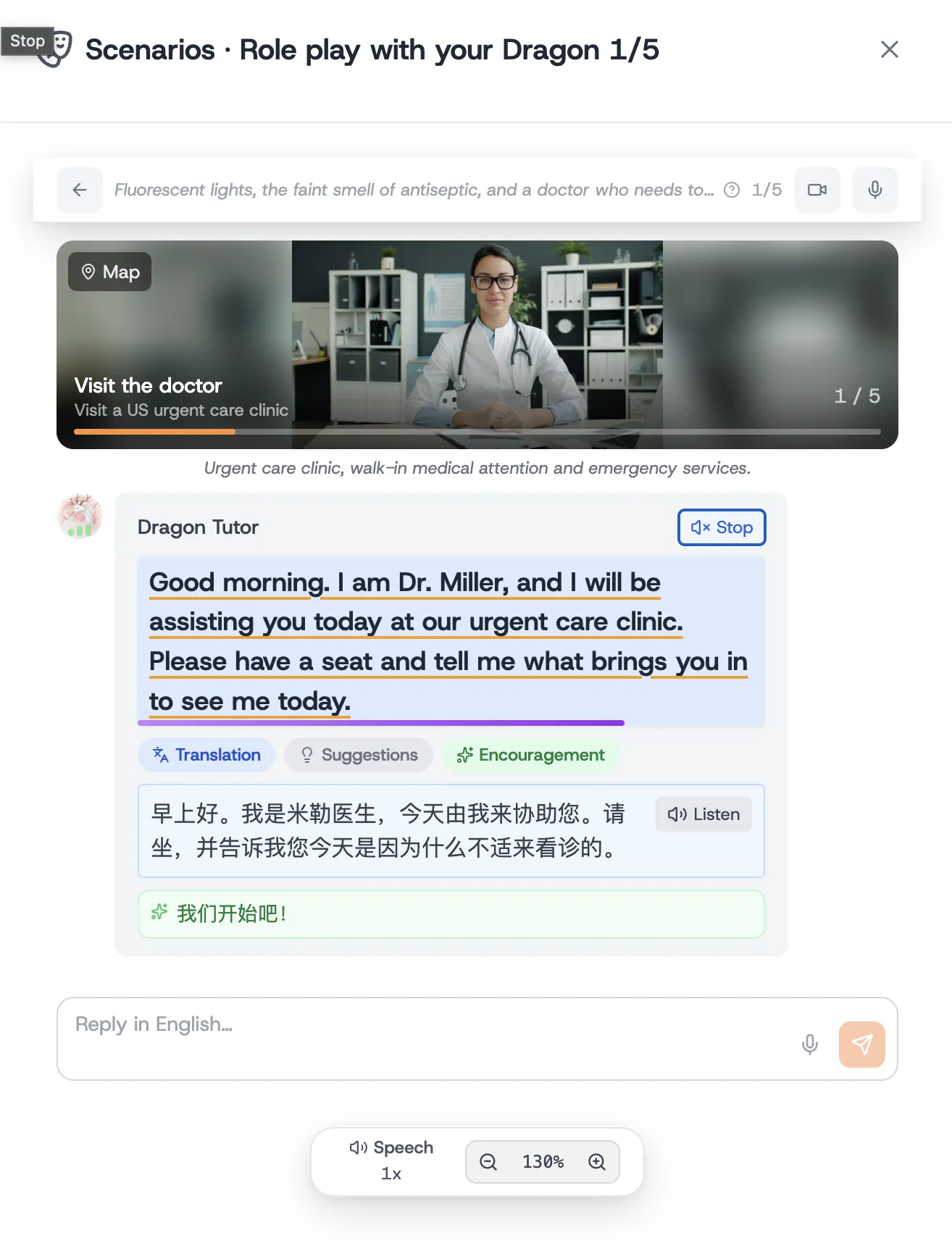
AI conversation Scenarios. Practise structured English conversations at any time without scheduling or paying per minute. Job interviews, shopping, making reservations, handling complaints. The AI adapts to your level and gives feedback on your responses.
Grammar corrections on writing. The Homework feature accepts free-form English writing and returns grammar corrections. The only tool on this list that addresses writing alongside speaking.
Games. Matching, vocabulary quiz, word rain, Shadow the Dragon for listening practice, and Type What You Hear for Pro users - all work with English content.
Where it falls short. ELSA has a larger library of pre-built phoneme drills and stronger long-term progress tracking across specific sounds. For maximum drill volume on phonemes with progress dashboards, ELSA goes deeper. Cambly and italki provide human conversation that no AI fully replaces. Hidden Dragon does not have a large pre-built English vocabulary curriculum - the built-in starter book covers 200 practical words, and beyond that you are generating your own content, which takes more effort than a structured curriculum.
Best for: Chinese speakers who want one tool that covers getting started, SRS, pronunciation, conversation, grammar, and story generation. Also the only option if you want to practise pronunciation on English that is specific to your goals, not generic drill content.
Price: Free tier includes pronunciation scoring, SRS, starter book, and games. Pro from $12.99/month - includes AI story generation, Scenarios, Homework, and vocabulary enhancements.
ELSA Speak
ELSA (English Language Speech Assistant) is the most widely used English pronunciation trainer for Asian learners. Its AI has been trained on data from Chinese, Japanese, Korean, and other language backgrounds, and it shows: the feedback is specific to the sounds Mandarin speakers actually produce incorrectly.
What it does well. Phoneme-level feedback with a large library of structured drills. ELSA identifies your specific weak sounds over time and prioritises them. The lesson library covers individual phonemes, connected speech, rhythm, and intonation. Progress tracking shows improvement across specific sounds over weeks.
Where it falls short. ELSA trains pronunciation on their content only. You cannot import your own text. The app tells you your th score is improving; it does not help you practise the English vocabulary that actually matters for your job or your exam. No grammar corrections, no graded reading, no conversation practice, no SRS. For drill volume on phonemes, ELSA is strong. For everything else, you need other tools.
Best for: Learners who want a large structured library of phoneme drills and long-term progress tracking on specific sounds.
Price: Free tier with limited exercises. Pro from $89.99/year.
Speechling
Speechling combines AI feedback with human coach corrections. You record yourself speaking English sentences and a human coach gives written feedback within 24 hours.
What it does well. The human feedback layer catches things AI misses: unnatural stress, awkward pausing, prosody issues that are technically correct but sound wrong in context. For Chinese speakers whose error patterns are systematic, human feedback is often more actionable than automated scoring alone.
Where it falls short. Not real-time. You record, wait, read feedback, record again. The free tier is limited to 10 submissions per month. No conversation practice, no vocabulary, no grammar corrections.
Best for: Intermediate to advanced learners preparing for professional contexts - job interviews, presentations, IELTS speaking - who want detailed feedback on subtler issues.
Price: Free tier (10 submissions/month). Unlimited from $19.99/month.
Cambly
Cambly connects you with native English speakers for on-demand video conversation. No scheduling, no minimum session length. Open the app, click a button, and within seconds you are talking to a native speaker.
What it does well. Real conversation with real people is irreplaceable. No app simulates the cognitive load of listening and responding in real time, managing turn-taking, and producing fluent speech under pressure. Cambly removes every barrier to that practice.
Where it falls short. Cambly tutors are not trained teachers or pronunciation coaches. Feedback quality varies by tutor. Some will correct your pronunciation systematically; most will just converse. The per-minute cost adds up quickly for regular practice.
Best for: Intermediate learners who have enough English to hold a basic conversation and need regular speaking practice to build confidence and fluency.
Price: From $12.49/month (15 min/week) to $51.99/month (unlimited). First lesson free.
italki
italki is the largest marketplace for online language tutors and teachers. Unlike Cambly, you browse profiles, read reviews, and book sessions with professional teachers or community tutors - including teachers who specialise in Chinese speakers learning English.
What it does well. Finding the right teacher is the key advantage. A teacher who specialises in Chinese speakers knows exactly which sounds to focus on and can build a personalised curriculum. Community tutors can be as cheap as $5-8 per hour, making regular practice accessible.
Where it falls short. Scheduling is required. Quality varies more than a curated platform. Finding a good tutor takes time.
Best for: Learners who want structured, teacher-led pronunciation coaching with someone who can build a curriculum around their specific goals.
Price: Community tutors from $5-8/hour. Professional teachers typically $15-40/hour.
Duolingo English
Duolingo offers English courses for Chinese speakers with Chinese as the interface language. It is a low-friction starting point.
What it does well. Effortless onboarding. The daily habit loop keeps learners returning. The gamification works for building vocabulary and basic reading comprehension. The Chinese interface makes it genuinely accessible for lower-level learners.
Where it falls short. The pronunciation feedback is basic: it detects whether you said the right word but does not give phoneme-level feedback. Speaking exercises are infrequent. Duolingo will not fix your th sounds or your English r. Think of it as vocabulary and habit-building, not pronunciation training.
Best for: Beginners who need a low-friction starting point and a habit engine.
Price: Free with ads. Super Duolingo from $12.99/month ($84/year).
HelloTalk and Tandem
Both apps connect you with native English speakers who want to learn Chinese, for language exchange. You help them with Chinese; they help you with English.
What it does well. Language exchange partners have a personal reason to stay engaged. The reciprocal structure builds real relationships and often leads to regular practice partners. Both apps have voice message, video call, and text correction features. Free.
Where it falls short. Your partner is not a teacher. Pronunciation correction is inconsistent. Not a substitute for structured practice.
Best for: Supplement to structured study once you have enough English to hold a conversation.
Price: Free. HelloTalk Pro and Tandem Pro available with additional features.
Comparison Tables
Pronunciation, SRS & Getting Started
| App | Phoneme feedback | SRS flashcards | Getting started |
|---|
| Hidden Dragon | Phoneme-level + mouth diagrams + tips | Yes (with pronunciation scoring) | Starter book with 200 words |
| ELSA Speak | Phoneme-level, large drill library | No | Drill library |
| Speechling | AI + human (async) | No | Limited free tier |
| Duolingo English | Basic | No | Gamified onboarding |
| Cambly | None (tutor-dependent) | No | None |
| italki | None (tutor-dependent) | No | None |
| HelloTalk / Tandem | None (partner-dependent) | No | None |
Conversation, Content, Grammar & Price
| App | Conversation | Grammar corrections | Your own content | Price |
|---|
| Hidden Dragon | AI Scenarios | Yes (Homework) | Generate your own stories + flashcards | Free / $12.99/mo |
| Cambly | Yes (on-demand) | Varies | No | From $12.49/mo |
| italki | Yes (scheduled) | Varies | No | From $5/hr |
| HelloTalk / Tandem | Yes | Partner-dependent | No | Free |
| ELSA Speak | No | No | No | Free / $89.99/yr |
| Speechling | No | No | No | From $19.99/mo |
| Duolingo English | No | No | No | Free / $12.99/mo |
What to Use and When
No single app covers everything. The most effective combination depends on where you are and what you need.
For a single app that covers everything from getting started to advanced practice: Hidden Dragon is the only option that spans SRS flashcards with pronunciation scoring, story generation, AI conversation, grammar corrections, and a starter onboarding path. If you want one subscription instead of three, this is the one.
For phoneme drill volume and progress tracking: ELSA is the strongest dedicated pronunciation trainer. Use it if you want a large library of structured exercises and a dashboard showing your specific sounds improving over time.
For pronunciation on your own content: Hidden Dragon is the only option. Generate a graded English story on your topic, turn it into SRS flashcards, score your pronunciation on that vocabulary. This is the right tool if you are preparing for a specific context - a job, an exam, a presentation - and want to practise the English that matters for that context.
For conversation practice: Cambly for on-demand, italki for structured teacher-led sessions. Hidden Dragon's Scenarios for AI-driven practice available any time at a fixed monthly cost.
For grammar corrections on writing: Hidden Dragon's Homework is the only tool on this list that addresses this.
For beginners who need to start: Hidden Dragon's starter book gives you 200 practical words with pronunciation scoring and SRS from day one. Duolingo is an alternative for gamified habit-building.
Most learners do not need all of these. If you want one tool that covers pronunciation, SRS, conversation, grammar, and vocabulary generation without juggling multiple subscriptions, Hidden Dragon Pro covers that surface. If you want the deepest standalone phoneme drill library, add ELSA. If you are preparing for something specific and want a human teacher who knows your error patterns, invest in a few italki sessions.
Frequently Asked Questions
What is the best English learning app for Chinese speakers?
It depends on what you need most. Hidden Dragon is the only single app that covers SRS flashcards with pronunciation scoring, story generation, AI conversation, grammar corrections, and a getting-started path - useful if you want one tool across multiple skills. ELSA Speak is the strongest dedicated pronunciation trainer with the largest drill library. For human conversation practice, Cambly and italki are better than any AI alternative.
What is the easiest English learning app for Chinese speakers to start with?
Hidden Dragon gives you a starter book with 200 practical words, pronunciation scoring, and SRS flashcards from the first session - no setup required. Duolingo English is also easy to start with a gamified habit loop and Chinese interface. The difference: Hidden Dragon starts correcting your pronunciation immediately, while Duolingo focuses on vocabulary first.
Does any app combine SRS flashcards with pronunciation practice?
Yes. Hidden Dragon is the only app that pairs SRS flashcards with phoneme-level pronunciation scoring. When you review a card, you say the word aloud and get feedback on specific sounds. Most other apps separate vocabulary tools from pronunciation tools, meaning you study words in one app and practise pronunciation in another.
How can a Chinese speaker improve English pronunciation at home?
Focus on the sounds that do not exist in Mandarin: the voiced and unvoiced th, the English r, word-final consonant clusters. Use an app with phoneme-level feedback - ELSA or Hidden Dragon - rather than one that only tells you whether the word was right. Record yourself and compare to native speaker audio. Practise regularly using SRS to ensure you do not forget: consistency over months matters more than intensity over a few days.
What English sounds are hardest for Chinese speakers?
The th sounds (both voiced and unvoiced), the English r, word-final consonant clusters like "strengths" or "texts", and vowel contrasts like ship vs sheep or full vs fool. English stress patterns are also persistently difficult: Mandarin is syllable-timed, English is stress-timed, and the difference affects how natural your speech sounds even when individual sounds are correct.
Is ELSA better than hiring a tutor?
For phoneme drill volume and systematic progress tracking, ELSA is more efficient and far cheaper than a tutor. A tutor is better for conversation fluency, nuanced feedback on real speech, and professional-context preparation. If you can only do one: use Hidden Dragon or ELSA first to fix your most obvious errors, then a tutor once you can hold a basic conversation and want to work on subtler issues.
Can I practise English speaking without paying per minute for a tutor?
Yes. Hidden Dragon's AI Scenarios let you practise structured English conversations - job interviews, daily situations, professional contexts - at any time, at a fixed monthly cost. Cambly's lower tiers give you limited human conversation time. HelloTalk and Tandem provide free language exchange partners. For most learners, a combination of AI practice for volume and occasional human sessions for quality is more sustainable than paying per-minute rates for every speaking session.
Hidden Dragon also works for English speakers learning Mandarin - the same pronunciation engine, stories, and conversation tools in the other direction. Try it for free.